Hello!
I’m Nobuyo (@nobuyo5696), currently thoroughly exploring Saitama Prefecture!
Speaking of well-known day-trip hot spring chains, probably one of the most famous is… yes, Gokurakuyu.
I feel like I see them all over the place, and for good reason—they reportedly have the highest number of branches in Japan, so many people probably think “day-trip hot spring = Gokurakuyu.”
Although Gokurakuyu is a chain, the atmosphere of the buildings and facilities varies quite a bit from place to place.
Even their biggest selling point, the hot spring water, has different mineral compositions depending on the region, making it fun to visit them one by one.
This time, I visited Gokurakuyu Ageo, located in Ageo City, Saitama Prefecture.
It is a somewhat small-scale facility situated right in the middle of a residential area.
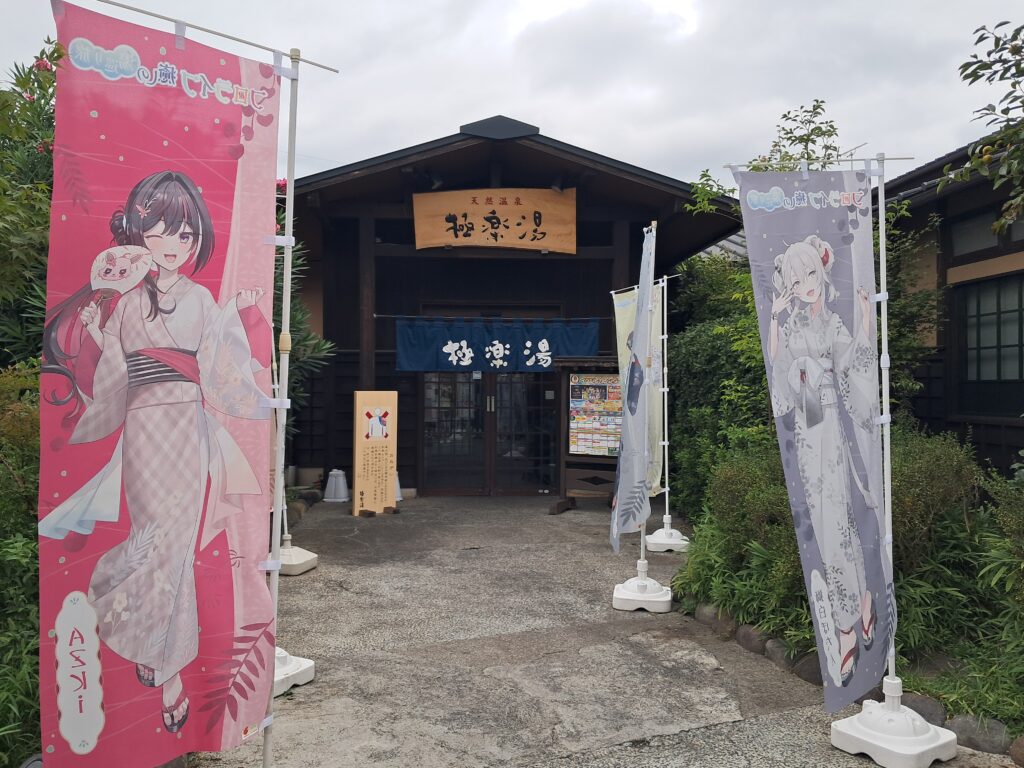
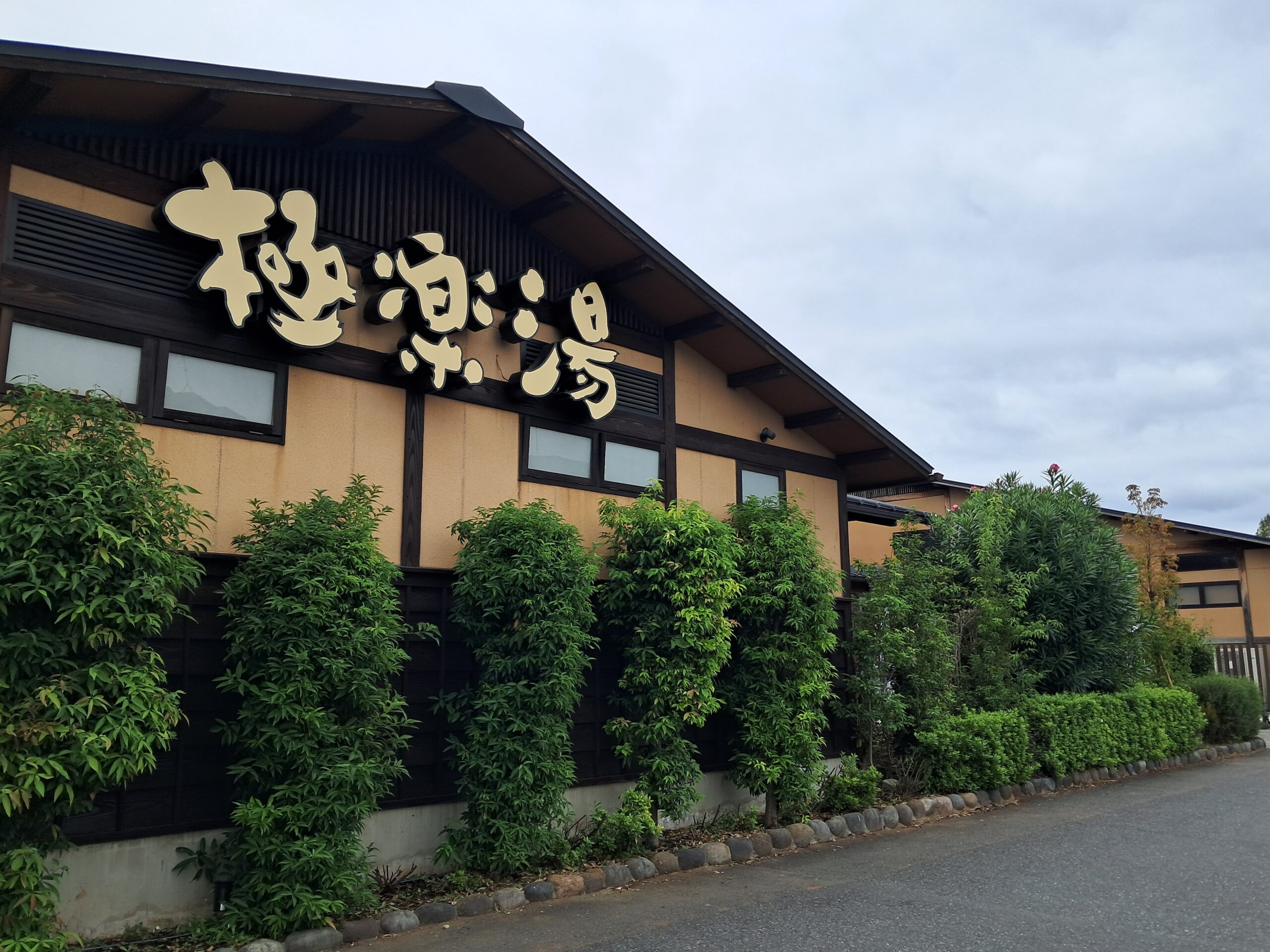
Any veteran Gokurakuyu fan across Japan will understand how the moment you see the exterior or entrance, you immediately get that “Ah, this is totally Gokurakuyu” vibe.
The Ageo surrounding area has many day-trip hot spring facilities scattered about with fierce competition, which naturally builds up anticipation.
So, this article is a review report of my visit to Gokurakuyu Ageo.
To put it bluntly right from the start: while the quality of the baths is quite good, the crowds were absolute madness…
- Basic Information for Gokurakuyu Ageo
- Infiltrating Gokurakuyu Ageo!
- Conclusion: Comprehensive Evaluation & Recommended Surrounding Sightseeing Plans
Basic Information for Gokurakuyu Ageo
Natural hot springs in a residential neighborhood. What Gokurakuyu Ageo is like!
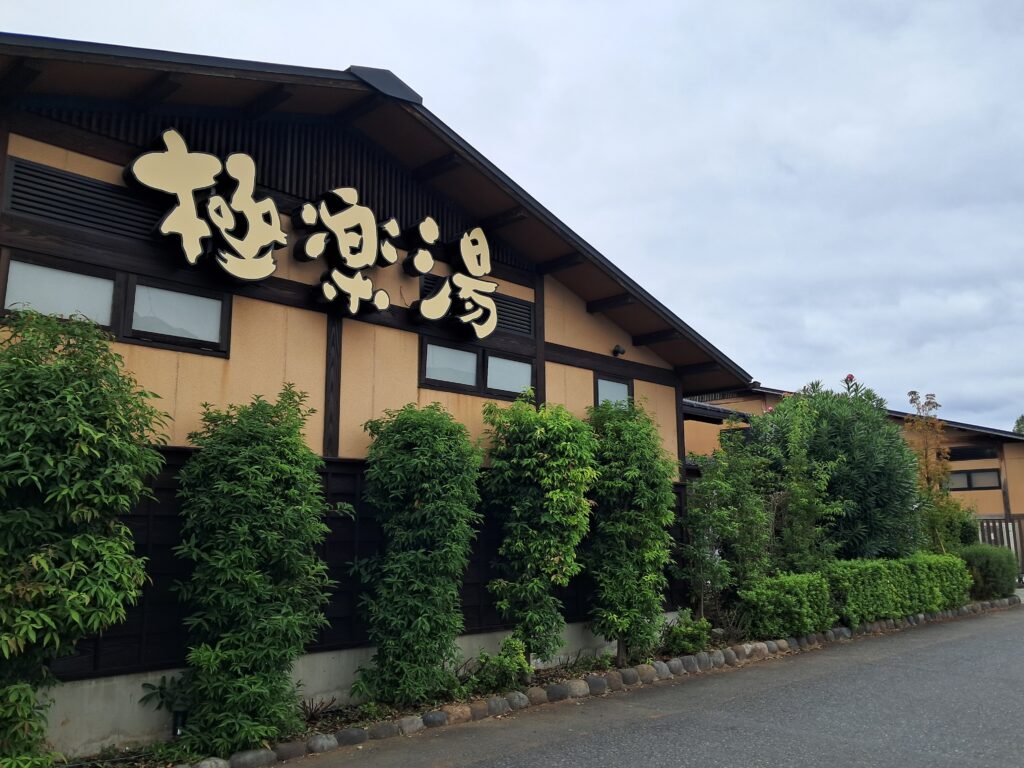
Gokurakuyu Ageo is a single-story bathing facility built in a residential neighborhood of Ageo City.
Its exterior, styled with a pure Japanese aesthetic, and warm-toned walls give off that distinct “This is so Gokurakuyu…” feel.
The site area is not very large (by Saitama standards), featuring a simple layout where everything—including the restaurant and resting space—is contained on a single floor.
Since it’s right in the middle of a residential area, it can’t be helped, but overall it gives the impression of limited space.
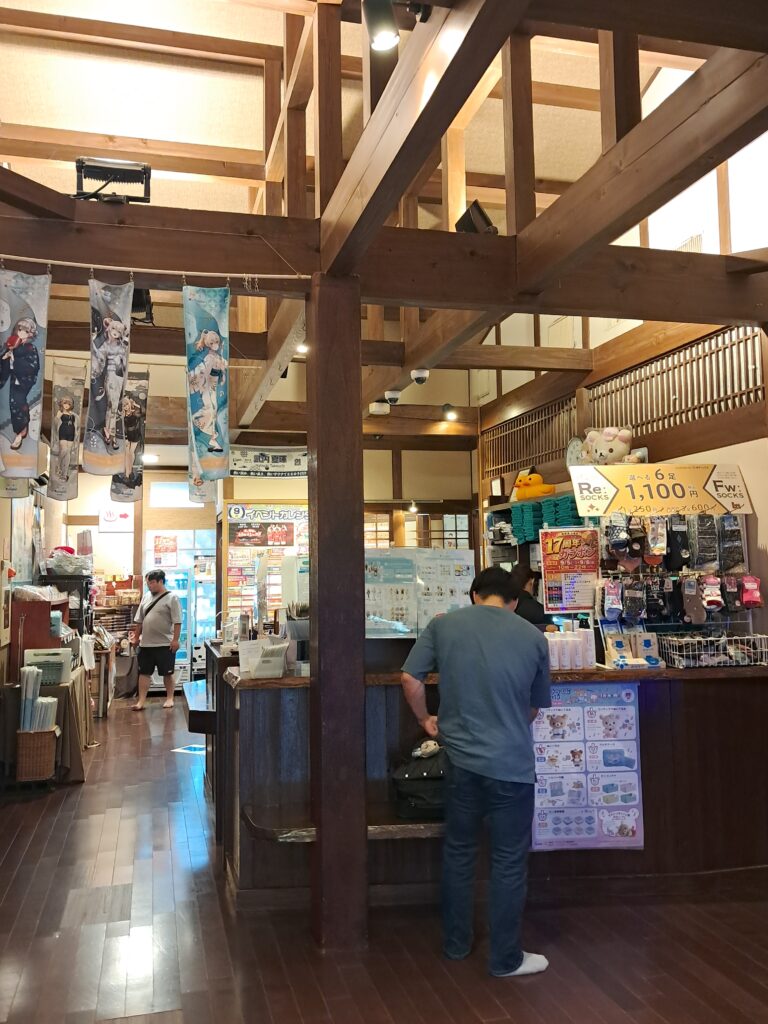
The interior design also follows the typical Gokurakuyu style, but Ageo’s branch is characterized by the heavy use of wooden pillars and beams.
The restaurant ceiling is built high, providing a sense of openness and a decent atmosphere.
I suppose it’s a campaign (?) common to all Gokurakuyu stores, but it’s strange how they weirdly push some mysterious anime characters.
Everyone seems to ignore them, and I wonder if there’s even any demand for it… (Well, they must have demand if they’re pushing it this hard).
Despite the limited site area, the attached restaurant doesn’t feel cramped, which is a plus (◎).
There’s also a small kids’ game corner, making it understandable why there are so many families with children.
At a glance, the building looks reasonably clean, but in reality, it feels quite aged.
Peeling floors, stains on the walls, and minor wear and tear are very noticeable throughout the building.
Gokurakuyu Ageo Opening Hours & Pricing
Here is the basic information for Gokurakuyu Ageo.
Reasonable pricing is one of Gokurakuyu’s charms, and Ageo’s conscience-driven pricing is much appreciated.
Towels are not included in the admission fee, so renting or buying them is best if you come empty-handed.
Shampoo, conditioner, and body soap are provided in the bathing area for free use.
Just like other Gokurakuyu branches, the men’s bath does not provide toner or lotion (Gokurakuyu tends to be cheap about these things).
There is no bedrock bath (*ganbanyoku* – traditional Japanese heated stone sauna), making it a simple facility focused purely on baths and food.
And though it’s probably common to all Gokurakuyu stores, the internal system is peculiar and, to be frank, a hassle.
In modern day-trip hot spring facilities, cashless post-payment systems are mainstream—where you exchange your shoe locker key for a settlement wristband at reception, charge all food and drinks inside to the wristband, and settle up upon leaving. Gokurakuyu uses a mysterious system that goes completely against this trend.
You keep the key to your shoe locker with you the entire time, and there is no wristband for in-house settlements.
Admission is a pre-paid system where you pay using a dedicated payment machine at the entrance, and any food, drinks, or shopping inside must be paid for individually at separate payment machines each time.
Furthermore, the payment machine at the entrance does not accept cards, only cash and smartphone payments.
Yet, the checkout machines used for settling restaurant bills accept credit cards—making it nonsensically inconsistent.
Every time you buy food or use a vending machine, you have to pull out your wallet, but since your wallet is left behind in the locker room, you have to keep walking back there… This quietly drove me nuts.
Gokurakuyu Ageo Spring Quality & Supply System
The spring quality at Gokurakuyu Ageo is sodium-chloride / hydrogen carbonate hot spring.
It is a colorless and transparent water that is quite rare for Saitama, with almost no salty taste or odor.
It has so little character that you might wonder, “Is this really a hot spring?”, but the slightly viscous feel on the skin confirms it’s definitely a hot spring.
While the warming sensation that penetrates deep into your body is weak, it is a “beauty bath (*bihada-no-yu* – hot spring water known for making skin smooth and beautiful)” that smoothly blends into your skin and leaves it feeling moisturized.
The water at day-trip hot spring facilities in Ageo City is uniformly of this slick, light hot spring type.
The spring quality at Gokurakuyu Ageo is by no means bad (in fact, it’s quite nice water), but it feels slightly weaker in mineral components compared to other facilities in the city.
At Gokurakuyu Ageo, the bathtubs supplied with hot spring water are located exclusively in the open-air area.
Regrettably, none of the tubs are *gensen kakenagashi* (unfiltered, free-flowing natural hot spring water directly from the source); all use a circulation system with chlorinated water (the chlorine smell is quite strong).
Gokurakuyu Ageo Crowding Levels | Clientele | Recommended Days & Times to Visit
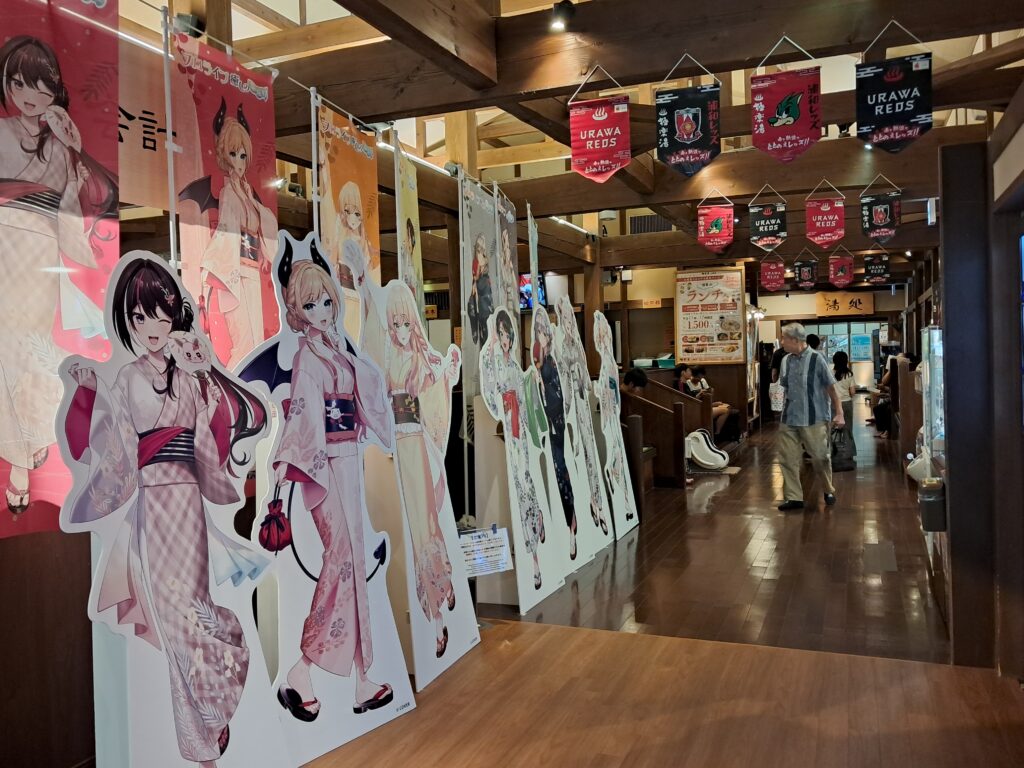
More than the atmosphere or the quality of the hot springs, what defines Gokurakuyu Ageo is the unbelievable level of crowding.
I visited around 4:00 PM on a Sunday, and from the moment I arrived, it was an endless, unending massive crowd. The bathing area overflowed with families with children, resembling an *imo-arai-jotai* (lit. a state of washing potatoes — extremely crowded and packed like sardines).
Families with children dropped off sharply after 7:00 PM, and by 8:00 PM the crowds were relatively better (though the number of people was still quite high).
…I’ll tell you straight: avoid visiting on weekends.
Instead of being healed by the hot springs, the sheer volume of people will just exhaust you.
The bathing areas (especially the open-air baths and sauna) are intensely crowded, and the cooling-down chairs set up outdoors are constantly fully occupied.
Including the restaurant and resting areas, the already narrow facility as a whole felt heavily congested.
Conversely, on weekdays, the crowds might be somewhat more tolerable?
Particularly, weekday nights after 8:00 PM might be the sweet spot (though I imagine it’s still way more crowded than the average Saitama hot spring facility).
The main demographic at Gokurakuyu Ageo is people in their 50s to 60s, with few young solo visitors.
There’s a fair impression of small groups of local high school students, and the crowd trends younger the later it gets at night.
Since I visited on a Sunday, it was completely packed with kids.
…Well, whatever, it’s fine if there are kids. What was absolute worst was that the children’s manners here were terrible.
(Though to some extent kids can’t help it,) it was a total zoo with children screaming and running around in both the baths and the restaurant.
It’s baffling that the facility management turned a blind eye, but it’s equally mysterious that the parents didn’t discipline them. I found myself thinking, “Seriously Ageo, you guys are hopeless…” Truly, please learn from the kids’ manners at Yoshikawa City’s hot springs…
Access to Gokurakuyu Ageo
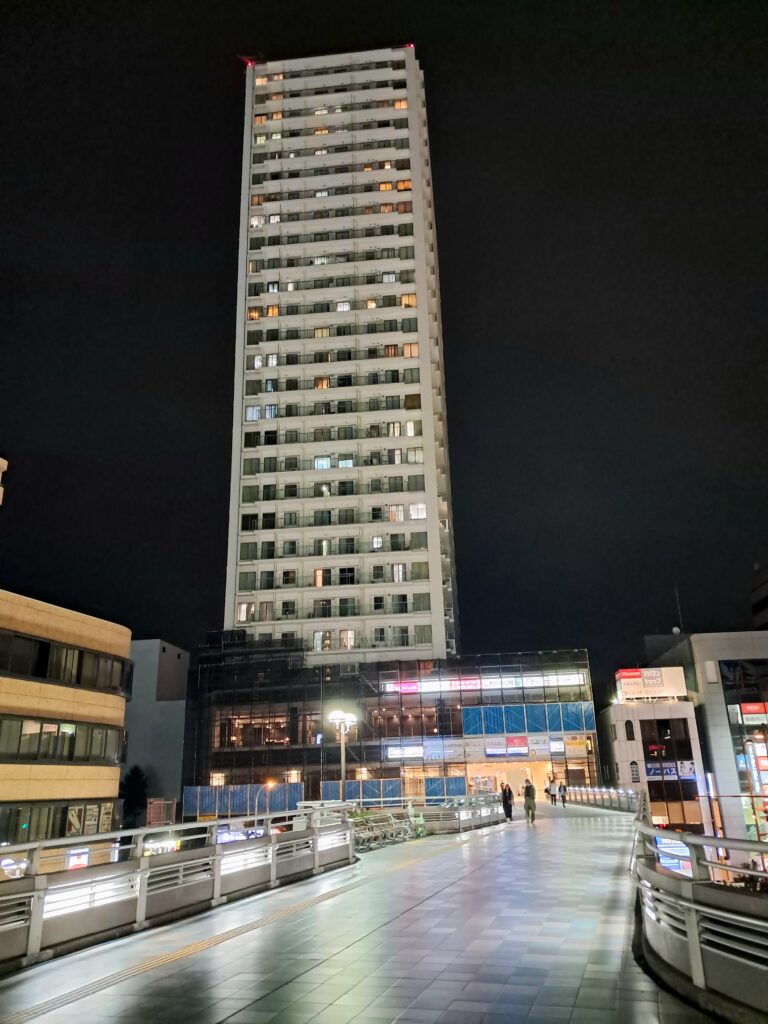
The closest station to Gokurakuyu Ageo is Ageo Station on the JR Takasaki Line.
It’s about 2 km from the station, roughly a 30-minute walk. It’s not strictly un-walkable, but honestly, it’s far.
Ageo City’s community bus “Gurutto-kun” stops right in front of the facility, but departures are extremely infrequent and inconvenient.
Since there is no free shuttle bus, getting there without a car leaves you with two choices: walk from the station or wait for the inconvenient bus.
I keep thinking, “It would be nice if they ran a free shuttle bus from the station…”, but honestly, since it’s already this crowded, they probably see no need to run one. Ah, the perks of a monopoly business!
▶ Tokyo Station ~ Ageo Station: Approx. 45–55 min via JR Takasaki Line (Ueno-Tokyo Line) | ¥720
▶ Shinjuku Station ~ Ageo Station: Approx. 40–50 min via JR Shonan-Shinjuku Line | ¥650–¥720
▶ Omiya Station ~ Ageo Station: Approx. 10–12 min via JR Takasaki Line | ¥200–¥250
※ From Ageo Station East Exit to Gokurakuyu Ageo, take the city bus Gurutto-kun “Kamihira Sugaya Kita-Ageo Line” or “Haraichi Circular” and get off at “Tennen Onsen / Gokurakuyu-mae” right outside. Takes 10 min | Adults ¥200 / Elementary students ¥100 | Timetables and route maps here (Ageo City Official Website)
If coming by car, it’s convenient because there is a large free parking lot right in front of the facility.
Infiltrating Gokurakuyu Ageo!
Now that we have a general idea of what Gokurakuyu Ageo is like, off to the hot springs…!
I will write frankly about my impressions after actually stepping inside and the parts where I thought, “It would’ve been better if they did this…”
Reception to Hall
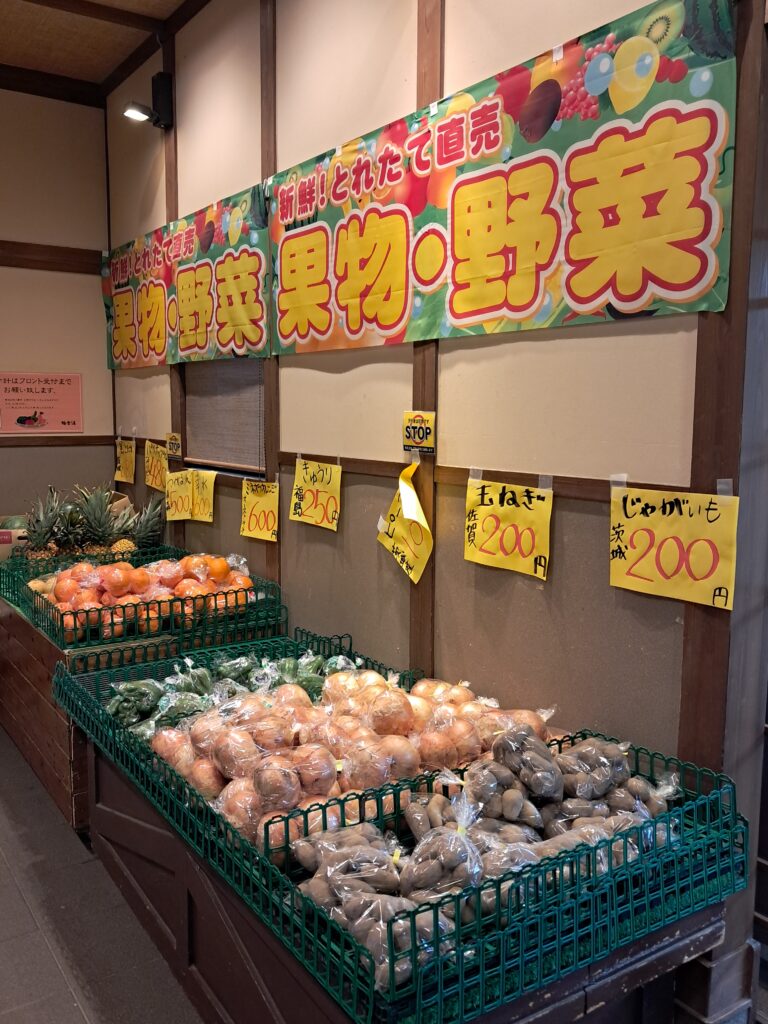
As soon as you step through the entrance of Gokurakuyu Ageo, you’ll find shoe lockers, a staffed reception counter, and a small souvenir corner.
Selling locally produced vegetables from Ageo gives it a nice community-rooted feel.
Once you lock your shoes, you keep the key yourself until leaving, so be careful not to lose it.
The system requires buying tickets from two vending machines next to reception and handing them to the staffed desk, where you also receive any necessary towels (even so, having ticket machines only to hand tickets manually to a staff member feels terribly inefficient).
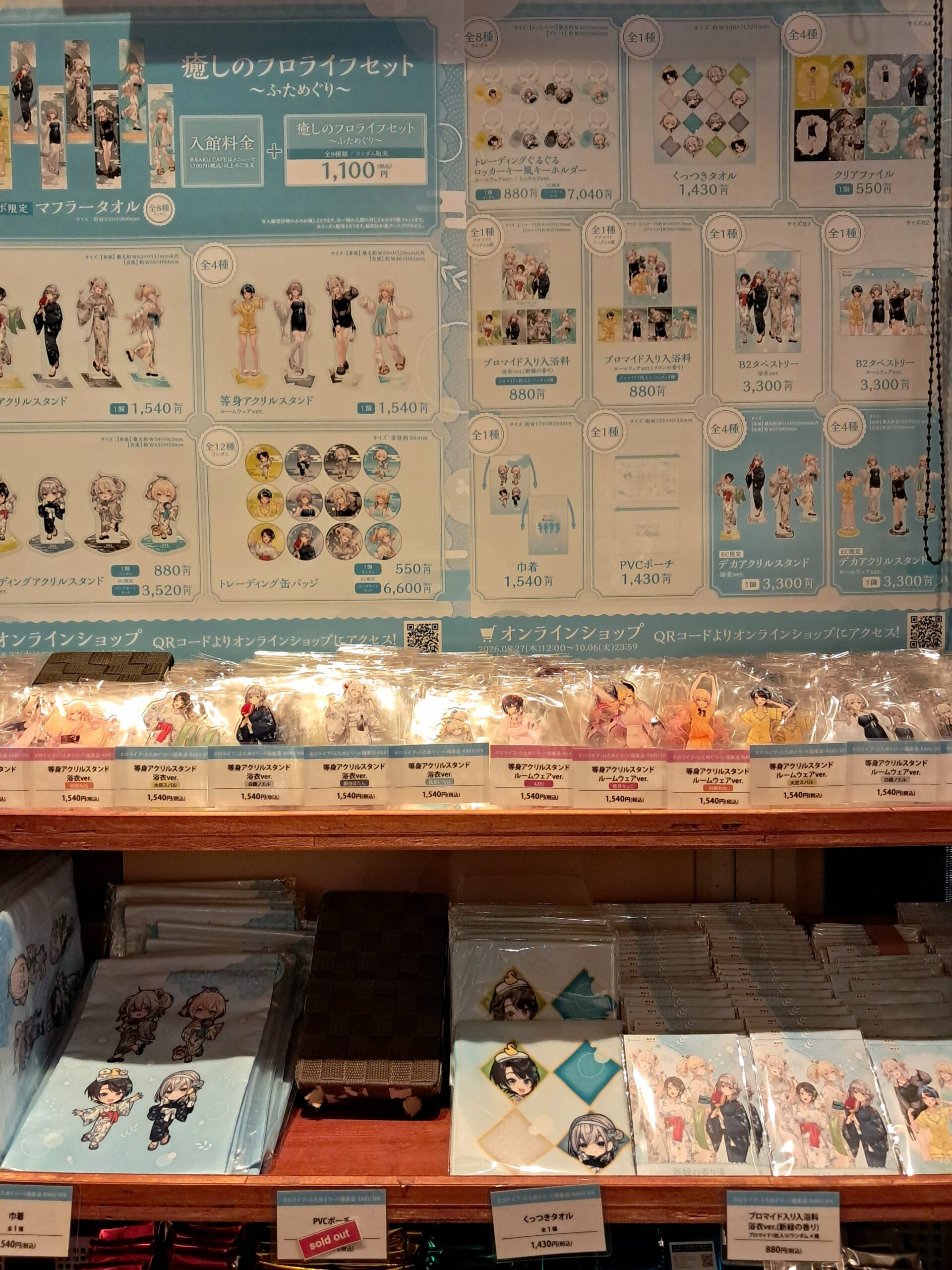
The reception staff’s service is reasonably friendly.
On the other hand, the attitude of the cleaning staff and bath attendants was poor. For instance, when replacing the trash can in the smoking room, they entered and left in total silence (normally people say “Excuse me”), and when a staff member tried to enter the bathing area from the changing room while a customer was exiting, they didn’t yield and forced their way through right at the doorway (unacceptable for customer service), leaving me with the impression of lacking basic staff training.
The Surprisingly Well-Executed Main Bathing Area
The Open-Air Bath Area Utilizing Elevation Differences
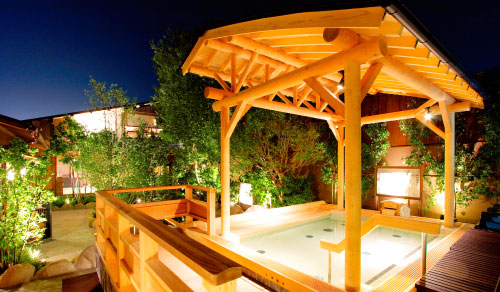
The biggest selling point of Gokurakuyu Ageo’s bath area and the primary reason for its popularity is its well-appointed open-air area (*rotenburo* – traditional outdoor Japanese bath).
The open-air space isn’t very large, and about half of it is covered by a roof, but strangely enough, it doesn’t feel oppressive.
The reason for this mysterious sense of openness is likely the spatial design utilizing elevation differences.
Because the carbonated Japanese cypress bath is set higher up than tubs like the rock bath or hollowed-out bath, a sense of depth is created within the space.
True to Gokurakuyu’s focus on saunas, rows of cooling-down chairs line the pathway in the open-air area, showing thoughtfulness.
However, since this pathway is the only thoroughfare in the open-air section, I found it annoying that you constantly have to walk right in front of people sitting in chairs when moving around.
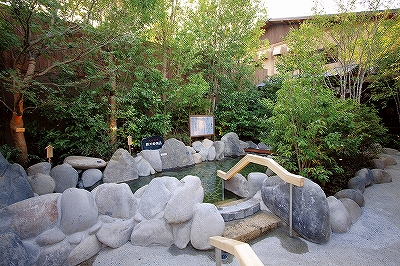
The main tub in the open-air area is the Hot Spring Rock Bath.
The water temperature is a comfortable 41.5°C—neither too hot nor too lukewarm—and because it’s spacious, the crowding is relatively manageable.
It features colorless, transparent water rare for Saitama, with a unique texture that clings to the skin.
There’s zero taste and the hot spring components feel slightly mild, but it was great that this tub had almost no chlorine smell.
It’s built quite thoroughly, giving a strong sense of a proper rock bath ambiance (◎).
The surrounding rocks act as a screen, keeping you hidden from other tubs in the open-air area, which made me think “Clever…” and left me impressed.
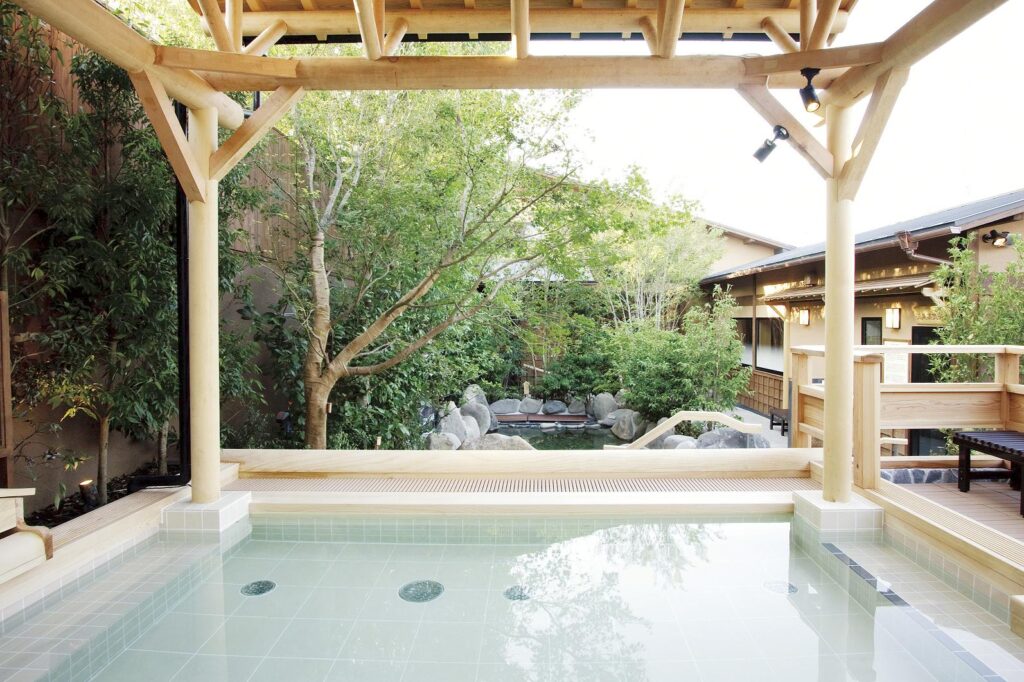
Located at the highest point in the open-air section is the Carbonated Cypress Bath (*Tansan Hinoki-buro*), set to a lukewarm 37°C.
This uses boiled regular tap water rather than hot spring water.
It features a TV, and because it’s quite lukewarm, you can soak for a long time, which is a nice touch.
The cypress tub atmosphere is also pleasant, and the open view overlooking the entire outdoor area is quite nice.
On the flip side, disappointingly, the carbonation itself is quite weak.
The tub only fits about 8 people so it isn’t huge, and since many people take long soaks, spaces rarely open up—which is a drawback.
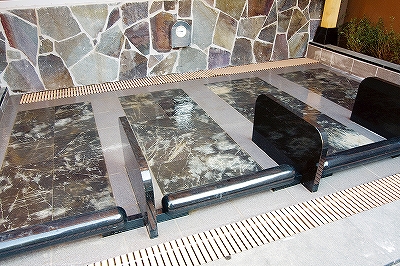
Tucked away at the very back of the open-air area is the Reclining Bath (*Ne-yu*).
The temperature is just right at around 40°C–41°C, and healing ores are embedded in the backrest section, giving a mild bedrock-bath effect.
Since there are only four seats, it’s constantly packed, which is tough, but once you find an opening, you’re golden.
Both the temperature and flow rate of the water running down your back are just right, and its unexpected comfort easily lulls you into a nap.
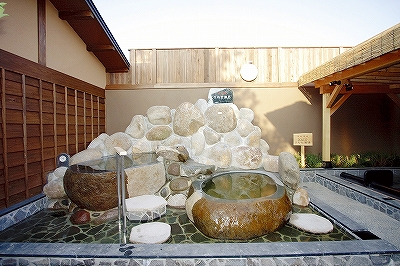
Acting as Gokurakuyu Ageo’s version of a pot bath (*tsuboyu* – traditional outdoor single-person ceramic or rock tub) is the 39°C Hollowed-out Bath.
True to its name, it’s carved out of rock and built larger than typical pot baths.
It’s big enough for two or three people, but for strangers to share it would be way too small and awkward…
So getting the tub all to yourself is great, but because it’s small, the bottleneck is that the chlorine smell feels stronger here than in other tubs.
Additionally, the hollowed-out bath sits right along the main pathway of the open-air section with people constantly passing by, meaning you get almost zero privacy, which is a bummer. Well, if you face away from the path, you can maintain a certain sense of having it all to yourself (it’s all about perspective).
The slightly lukewarm temperature lets you soak leisurely, but the downside is that people rarely leave.
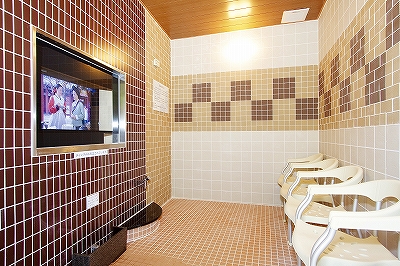
Something rarely seen in other hot spring facilities is the Hot Spring Mist Sauna tucked into a corner of the open-air area.
It’s a small room holding about 5 people with a room temperature around 60°C, filled with steam designed to let you warm your body gradually while inhaling the vapor.
The type of steam changes depending on the season, and this time it was a radon vapor bath.
It sounded like it would be good for health, and since it’s a rare type of sauna not often found in modern hot spring facilities, I was excited—however, the interior was filled with a stagnant, stale odor.
It wasn’t the smell of hot springs or radon, but rather that unpleasant locker-room-at-a-public-pool smell.
The floor also felt slimy, and cleanliness was questionable, so I made a quick retreat.
The Indoor Bath Area with No Hot Spring Tubs
Connecting from the open-air area, the indoor bath area contains zero hot spring bathtubs.
Half of it is a shower section, while the remaining half features various tubs, a sauna, and a cold water bath.
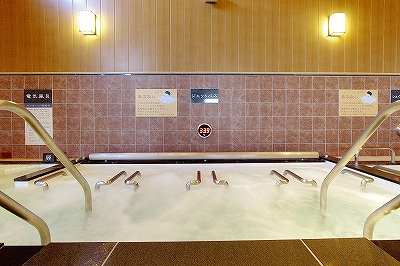
The main attraction in the indoor area is an assortment of attraction baths (jet baths).
There are 4 deep aesthetic bath seats and 4 jet bath seats, and I was glad to find them relatively uncrowded.
The number of jets and their pressure are on the modest side, but perhaps that makes it just right.
(https://www.gokurakuyu.ne.jp/tempo/ageo/index.html)
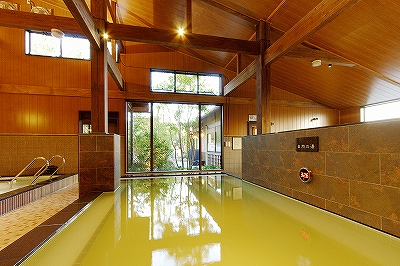
And what’s presumably supposed to be the main tub of the indoor area is called the “Nature Bath“.
It seems it used to draw real hot spring water, but nowadays it’s just regular water mixed with changing seasonal bath salts—a common gimmick. …Um, exactly which part of this is “Nature”?!
The water temperature is fine at 39°C, but with its overtly chemical colors and scents reminiscent of bath salts, its purpose feels lost on me.
I kept thinking, “Since hot spring water is already bubbling out of the ground here, they should just honestly pipe that in…”
Occupying half of the indoor area, the shower corner has about 30 stations, which feels a bit sparse relative to the crowds.
The showers are push-button style, running for about 10 seconds before stopping on their own. None of them feature privacy partitions separating you from neighbors, and the tight spacing between adjacent spots is quite bothersome.
The Sauna is Centered Around a High-Temperature Dry Sauna
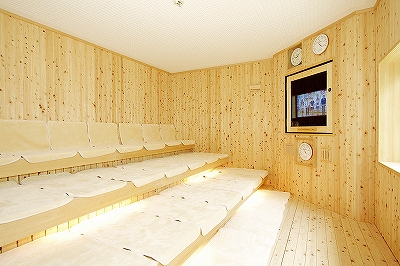
Gokurakuyu is famous for putting effort into its saunas across all branches.
Gokurakuyu Ageo features two types: the aforementioned hot spring mist sauna and the high-temperature sauna located in the indoor area.
The three-tiered high-temperature sauna is compact, accommodating about 25 people. The indoor thermometer shows 70°C on the lower tier and 90°C on the upper tier, and it feels roughly that warm physically. It’s a decent sauna overall.
There is no automatic *löyly* (Finnish steam-releasing method), and the style requires placing an individual personal sauna mat on top of the towels laid out on the floor.
The sauna interior is kept relatively clean with no noticeable odors or dirt, but the minus point is that it is constantly packed and jam-packed tight.
Features like the double-door sauna entrance and the drinking water dispenser stationed right outside the exit give off that “As expected of Gokurakuyu, they get it” vibe.
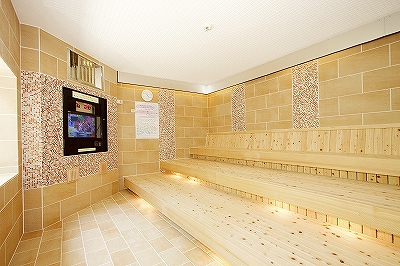
(https://www.gokurakuyu.ne.jp/tempo/ageo/index.html)
▲ By the way, the sauna in the women’s bath features an aroma *löyly* type, making it a different variety.
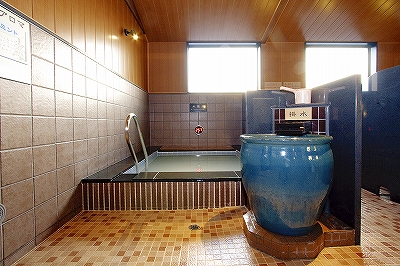
The cold water bath positioned right outside the sauna exit is set at 17°C and is narrow, accommodating about 4 people.
While cold, it isn’t bone-chillingly icy. Still, being able to step straight from the sauna into it is a nice touch.
Rules like no diving or face-washing in the cold bath are strictly enforced.
Given how crowded the sauna is, the fact that someone is always occupying the cold water bath is perhaps a drawback.
Other Facilities (Resting Space | Restaurant, etc.)
An Over-Capacity Resting Space
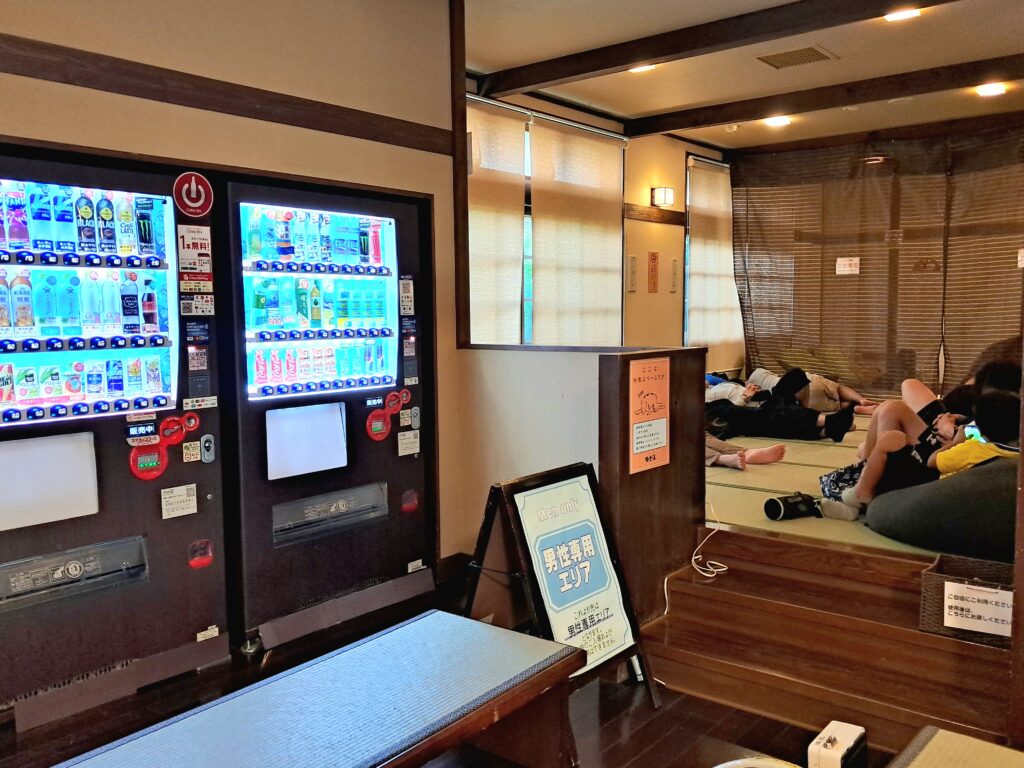
The resting space at Gokurakuyu Ageo is quite weak.
While Gokurakuyu as a brand has stores with well-equipped resting areas like the Hanyu branch, Ageo’s space can hardly be called a place to relax.
That’s because the only place to lounge leisurely inside this facility is a single small tatami room separated by gender. That’s it. There are no other spaces where you can stretch your legs out.
Since the tatami room itself isn’t large, it fills up instantly during peak hours, meaning the resting space’s capacity completely fails to match the crowd levels.
Otherwise, there are just a few bench-style chairs lining the corridor leading to the main bath.
Aside from restaurant seating, I think places to unwind comfortably after a bath are severely lacking.
There are virtually no manga or magazines provided, and no real manga corner to speak of.
Consequently, you are forced into a traditional public-bath (*sento* – traditional Japanese neighborhood communal bathhouse) style of usage: “take a bath, eat food, and head straight home,” which is highly regrettable.
A Delicious and Cost-Effective Restaurant
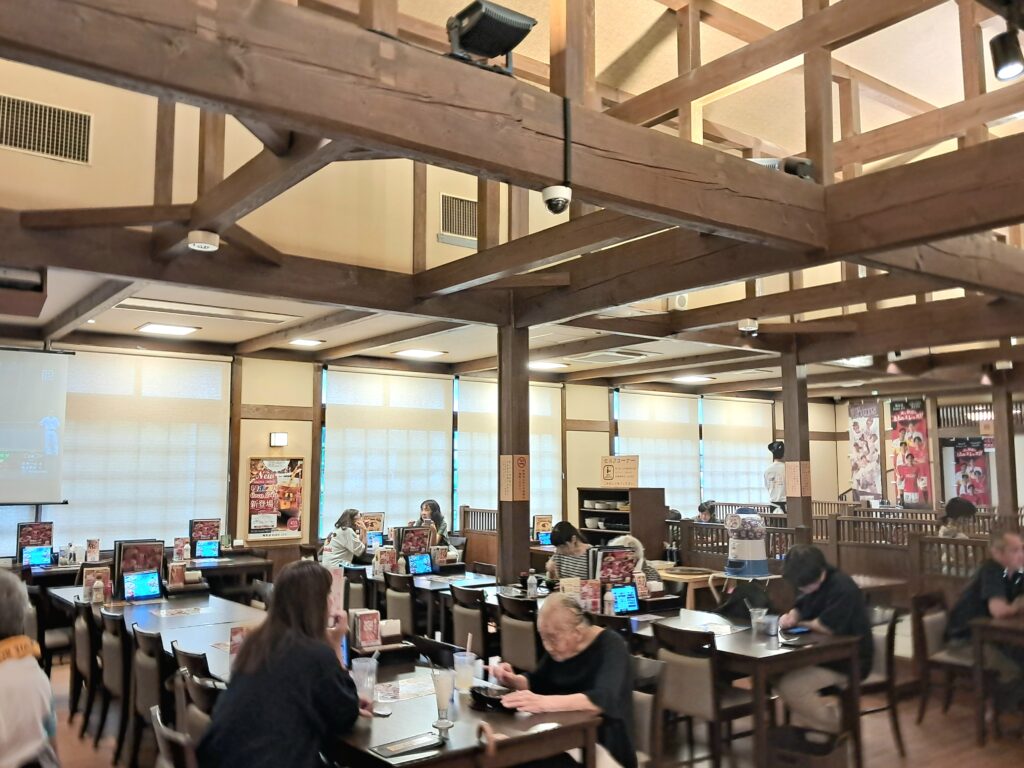
The restaurant at Gokurakuyu Ageo feels like it’s trying hard.
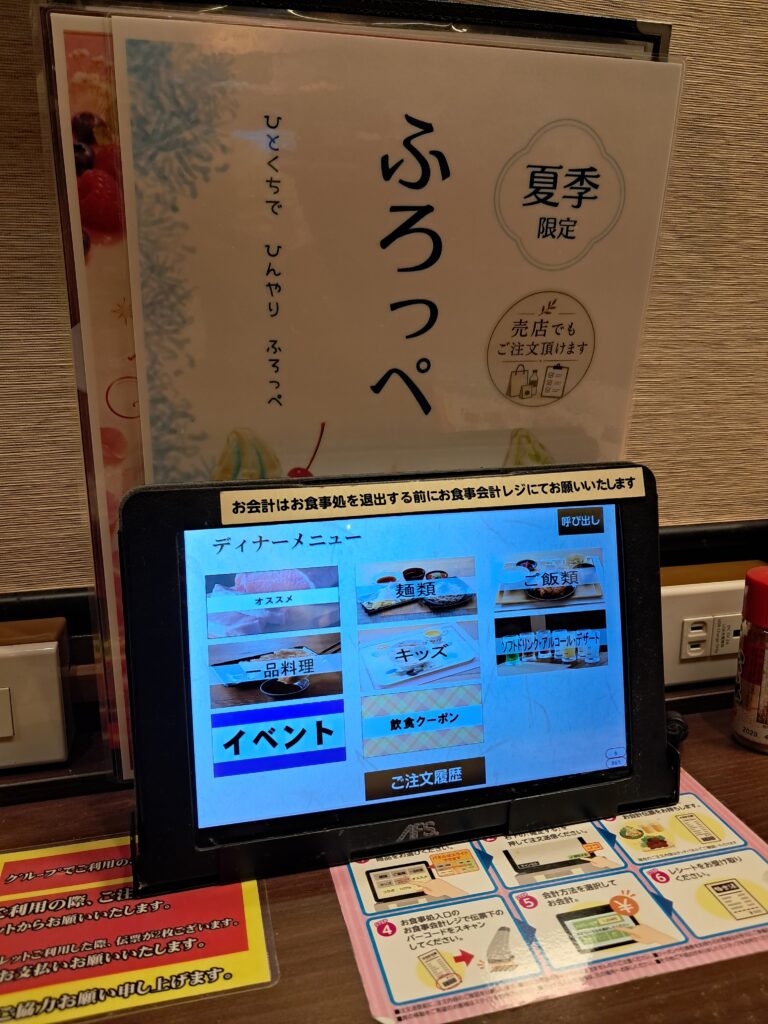
As mentioned earlier, it uses a baffling system where you order on a tablet and pay at an automated kiosk, but staff actually bring the food to your table, making it a sort of “semi-self-service” setup.
Staff service is generally friendly, and the restaurant’s atmosphere isn’t bad.
Operating the tablet was slightly confusing and took some adjustment at first, but once you get used to it, it’s fine.
The ability to use credit cards at the restaurant’s automated payment kiosk is a welcome point (though I’ll repeat: it makes zero sense that you can pay for food with a card while the entrance ticket machine doesn’t accept them).
Seating is roughly half tables and half tatami-mat seating, with a favorable impression given by the inclusion of single-person counter seats.
The menu likely follows standard Gokurakuyu-wide offerings centered around day-trip hot spring staples, but prices are relatively reasonable. ▼
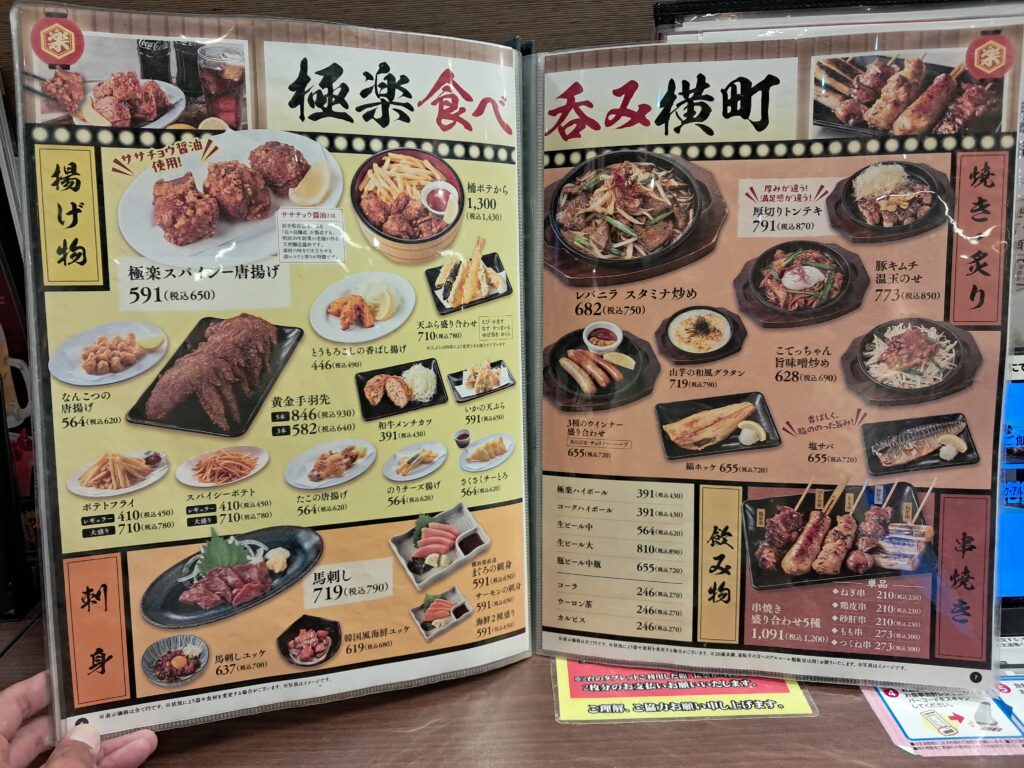
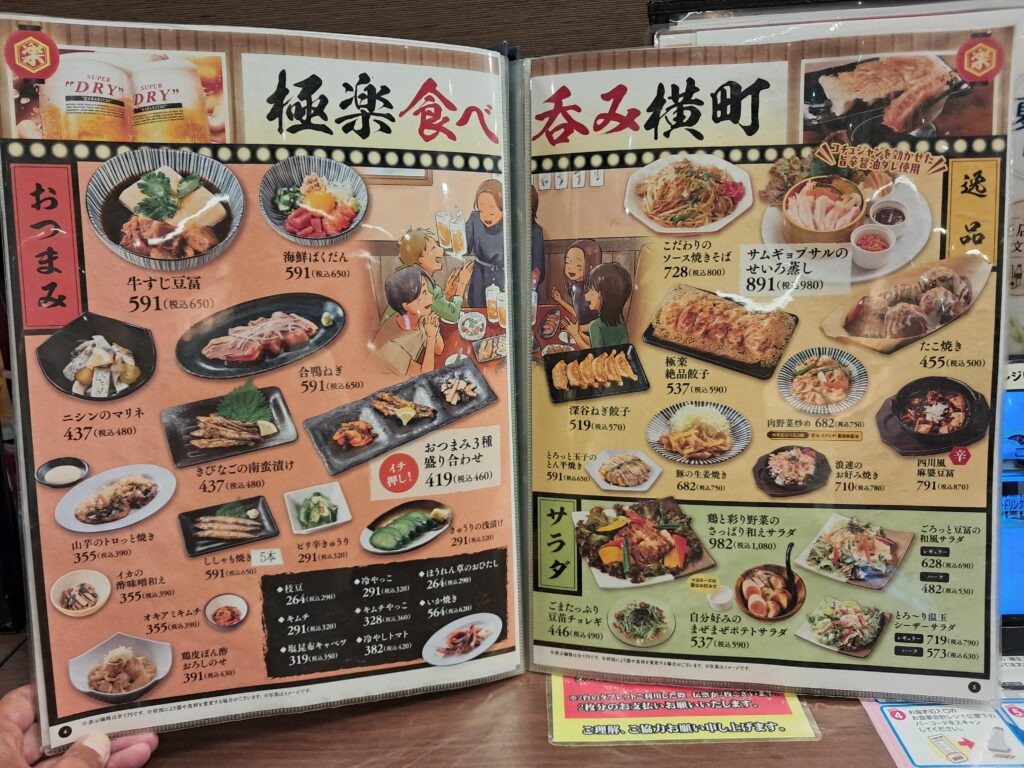
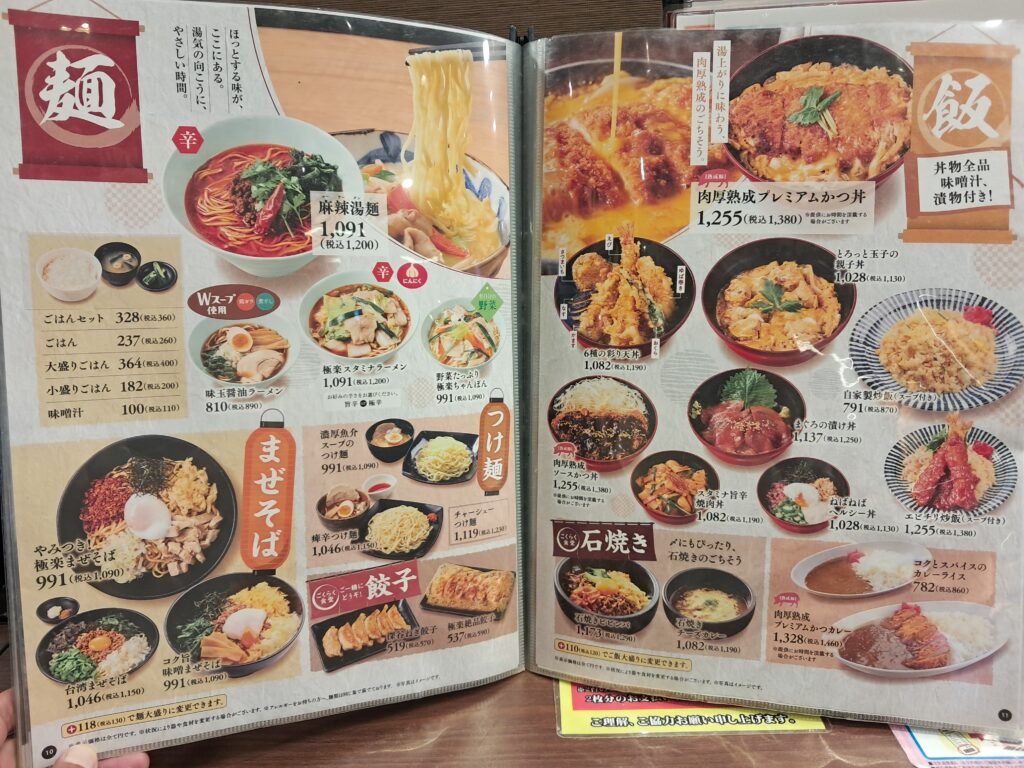
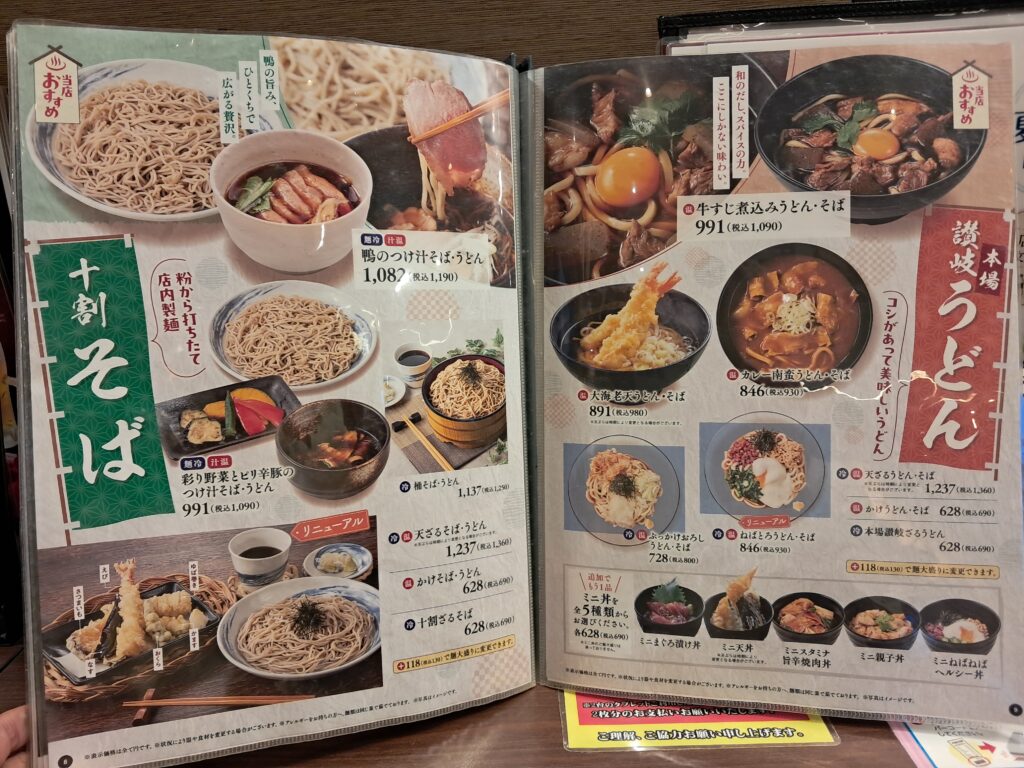
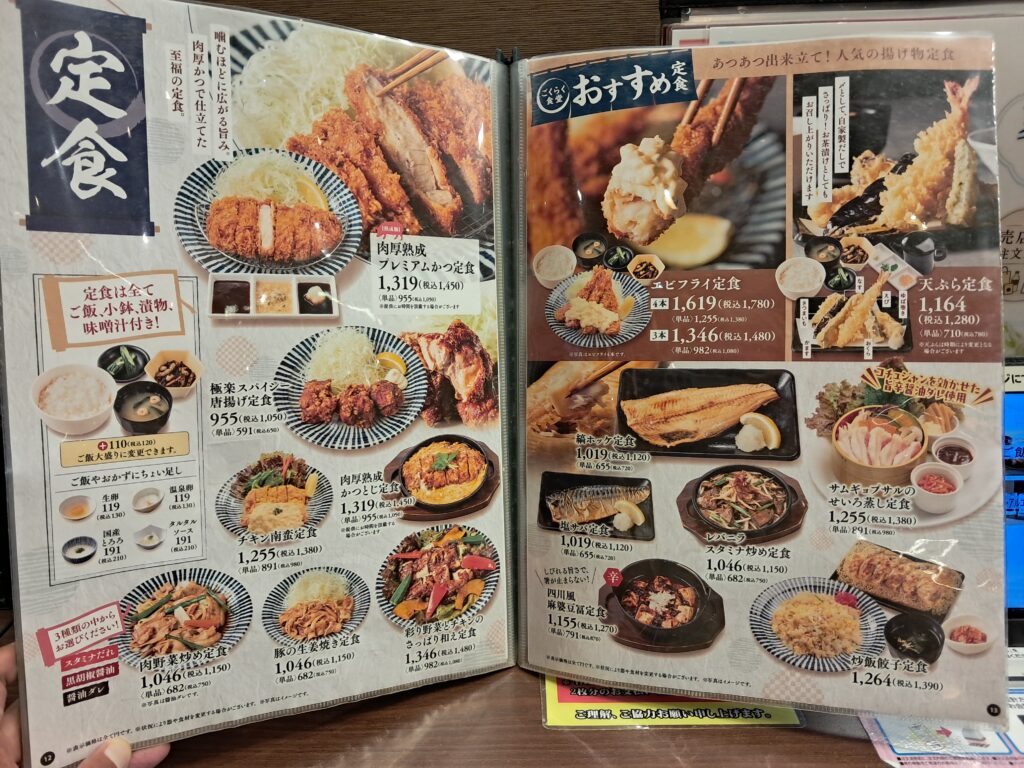
Aside from these common Gokurakuyu menus, I discovered something interesting.
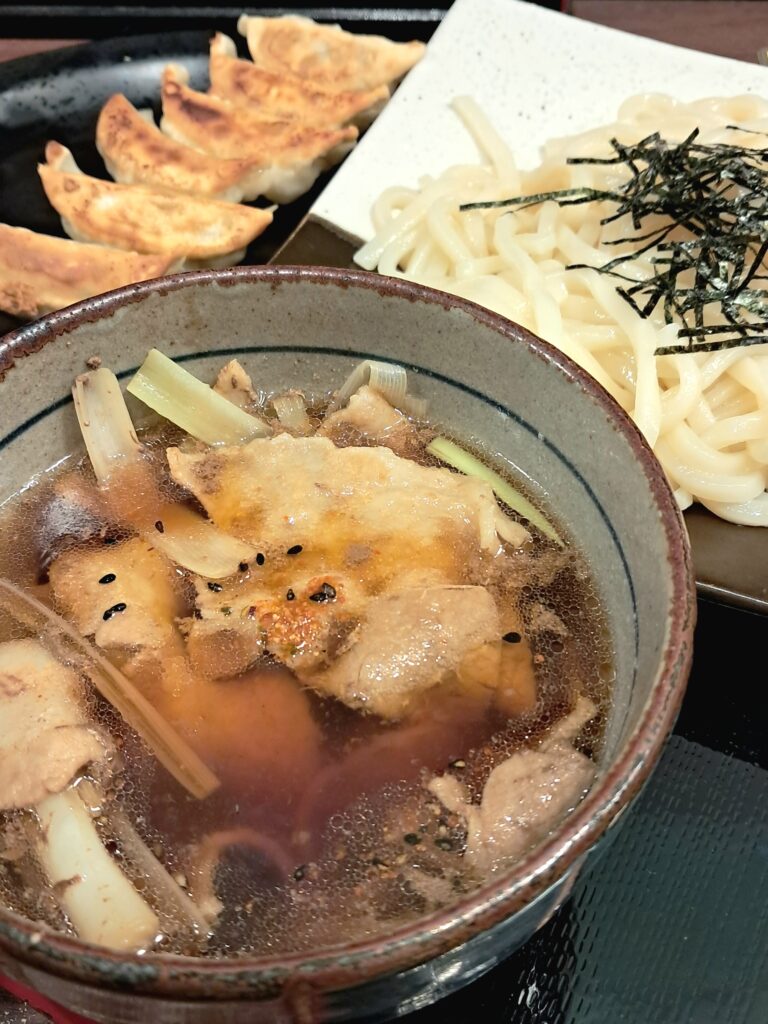
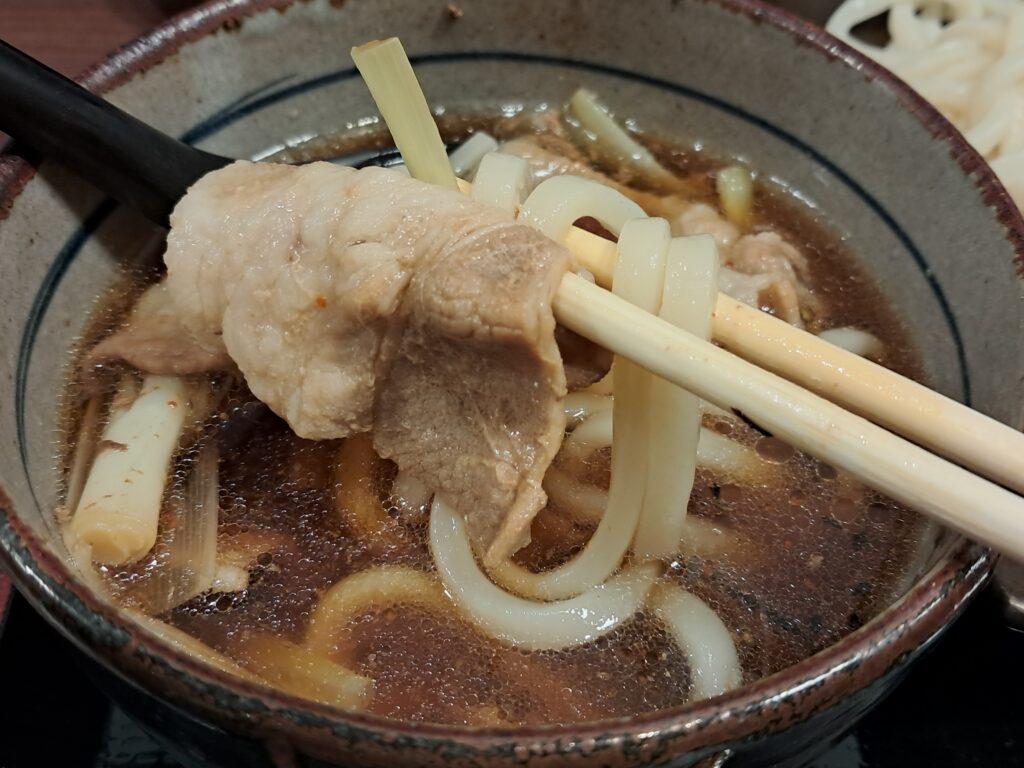
It’s the “Ageo Tsukejiru-udon,” which appears to be exclusive to the Ageo branch.
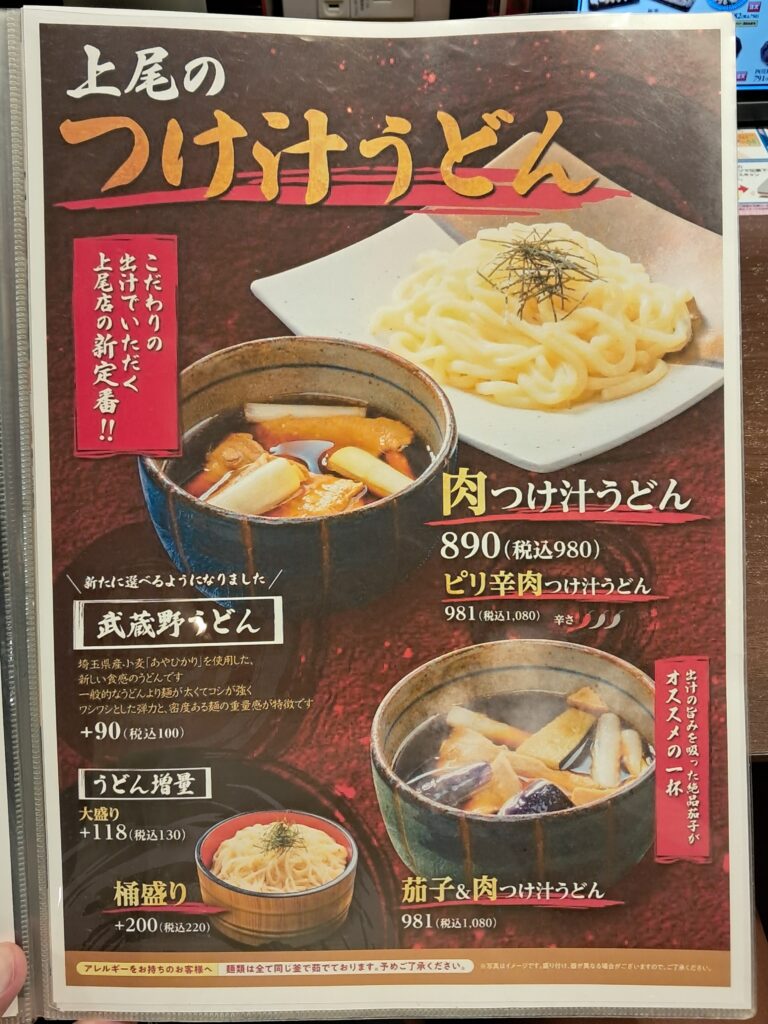
Tsukejiru-udon refers to meat-broth udon (*niku-jiru udon*), famously renowned as a culinary specialty of Saitama.
It’s a dish where you dip cold noodles chilled in ice water into a warm dipping broth simmered with pork and green onions.
As someone completely defenseless against the sales pitch of “region-limited,” I naturally ordered this Ageo Tsukejiru-udon.
I also added Fukaya onion gyoza dumplings, containing Saitama’s famous Fukaya green onions as an ingredient. ▼
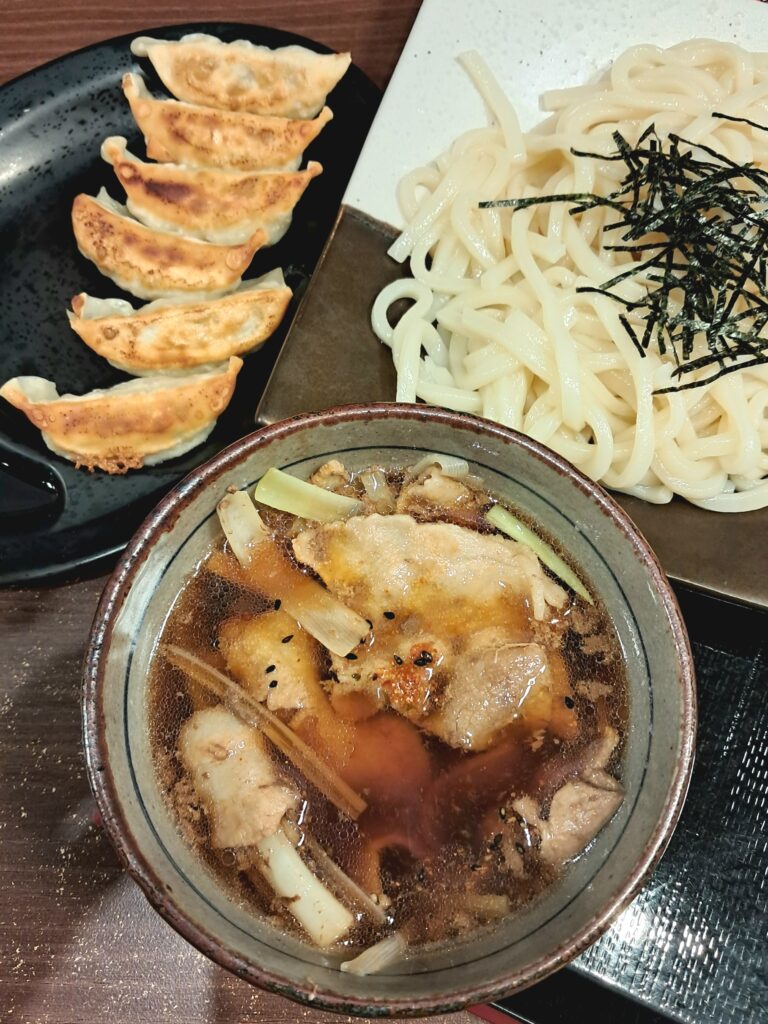
As for the Tsukejiru-udon, its level of execution was quite high for a restaurant attached to a hot spring facility.
It came packed with plenty of sliced pork, and the portion size was satisfying without complaint. The soup offered a deep umami flavor and richness that tasted exceptionally good.
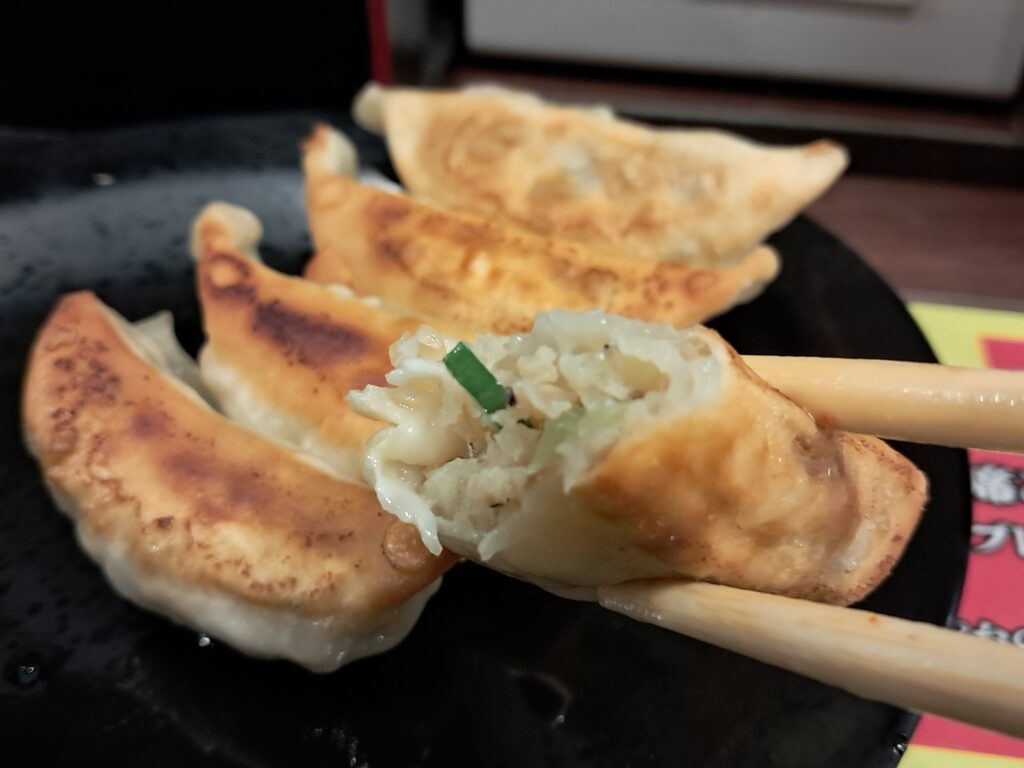
On the other hand, the Fukaya green onion gyoza made me wonder, “Hey, are these… just regular frozen gyoza…?” due to how underwhelming they were.
While not exactly tasting bad, the wrapper’s ruffled edges felt insufficiently cooked, and charging ¥570 felt a bit like a rip-off.
Since the Tsukejiru-udon was thoroughly satisfying, savoring flavors unique to the Ageo branch is definitely an option.
However, on Sunday evenings, the restaurant area was dominated by scenes of children running around and screaming near the tatami seating, making it a slightly tough environment to dine in peace (Ageo parents, seriously discipline your kids).
Conclusion: Comprehensive Evaluation & Recommended Surrounding Sightseeing Plans
Comprehensive Evaluation of Gokurakuyu Ageo
With that, let’s evaluate Gokurakuyu Ageo comprehensively across all fronts.
It wasn’t bad, but I can’t deny a vague sense of underachievement, falling short of a “supreme hot spring experience!”…
・Access: 4/10
・Uncrowdedness: 1/10
・Staff: 3/10
・Bathing Area Openness: 5/10
・Cleanliness: 3/10
・Hot Spring Quality: 7/10
・Bath Variety: 8/10
・Sauna: 6/10
・Locker Room Amenities & Supplies: 4/10
・Convenience of Facility System: 3/10
・Clientele Quality: 4/10
・Atmosphere: 6/10
・Food: 8/10
・Resting Space: 3/10
・Cost Performance: 5/10
・Overall: 4.6/10
Oh my… what’s this… we’ve hit our first-ever score in the 4-point range… Alas, poor Ageo branch.
To list the good points first: the atmosphere of the open-air area, the diverse variety of bathtubs, and the reasonable admission fees.
The restaurant’s great cost performance is also wonderful, making it ideal for fully enjoying a bath and a meal during uncrowded weekday hours.
On the other hand, regarding practically everything else, it might be considered a rather mediocre facility.
It’s disappointing that the spring quality isn’t bad yet lacks a free-flowing source, and since the resting space is genuinely limited, it’s not well-suited for lounging around all day, leaving me personally feeling “Hmm…”
There also seemed to be plenty of areas where facility management could improve, such as lackluster staff service, overly lax cleaning, and a nonsensical payment system.
Therefore, Gokurakuyu Ageo isn’t a place to visit with the goal of deep relaxation, but rather better suited for a quick change of pace through a sauna and a bath.
I will repeat this because it’s very important: strictly avoid weekends. It is hell.
Things to Sightsee Together with Gokurakuyu Ageo…
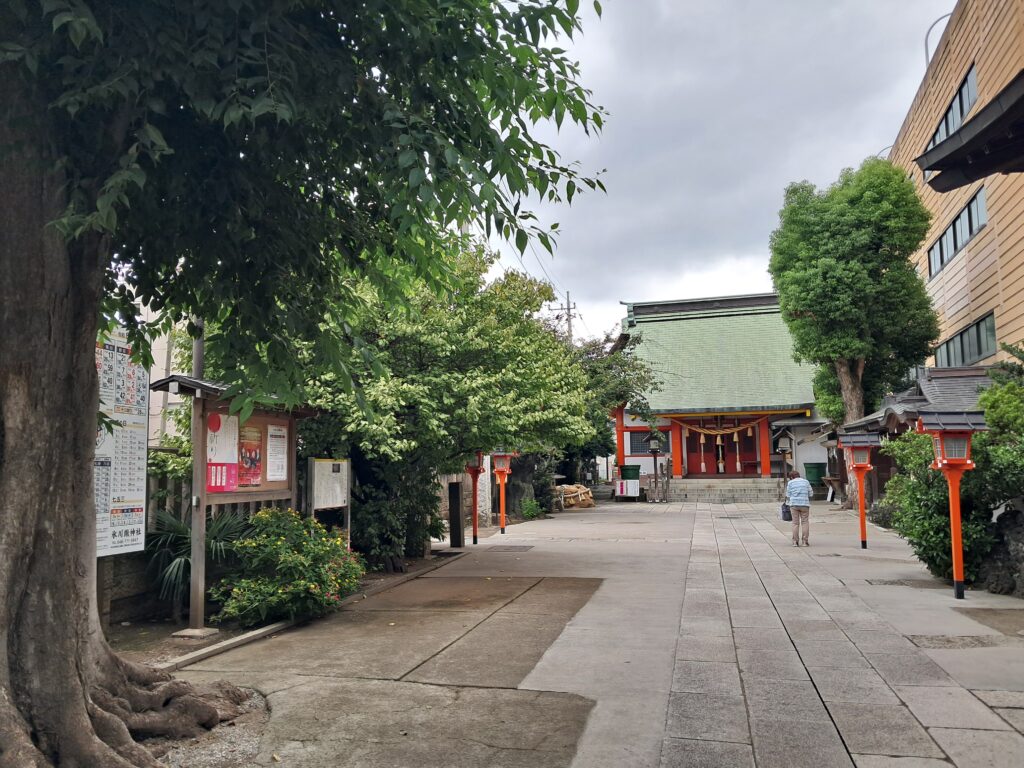
Ageo City, home to Gokurakuyu Ageo, is a town located just north of Saitama City, the prefectural capital.
It feels somewhat lacking in striking tourist attractions, but if you broaden your perspective slightly, there are a few charming spots scattered about.
Two Faces: A Post-Town Center and an Arakawa Riverfront Area!: Ageo City
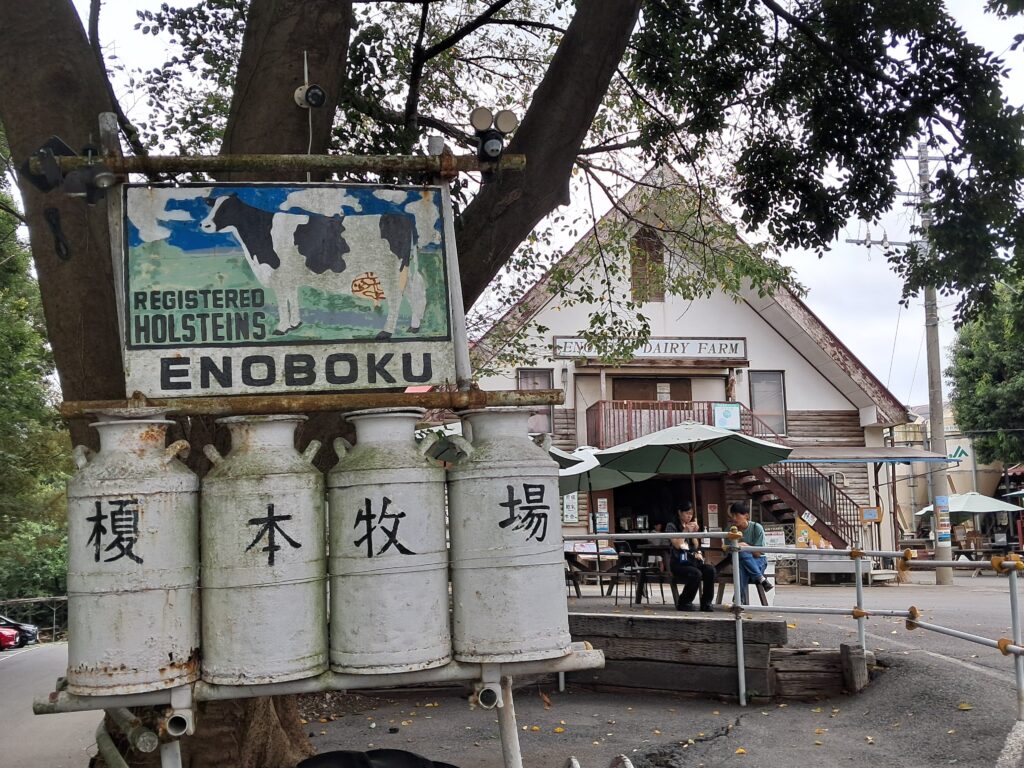
Ageo City is a town with a history of flourishing as a post town (*shukubamachi* – historical post station town along ancient highways) along the Nakasendo highway.
Today’s central district retains almost none of that old-time ambiance, and sights in the center are limited.
Meanwhile, the area along the Arakawa River away from the center radiates a unique presence and charm.
From a wild cycling road to a dairy farm selling signature soft-serve ice cream, you can discover an undiscovered side of Ageo.
Saitama’s Biggest Metropolis: Omiya
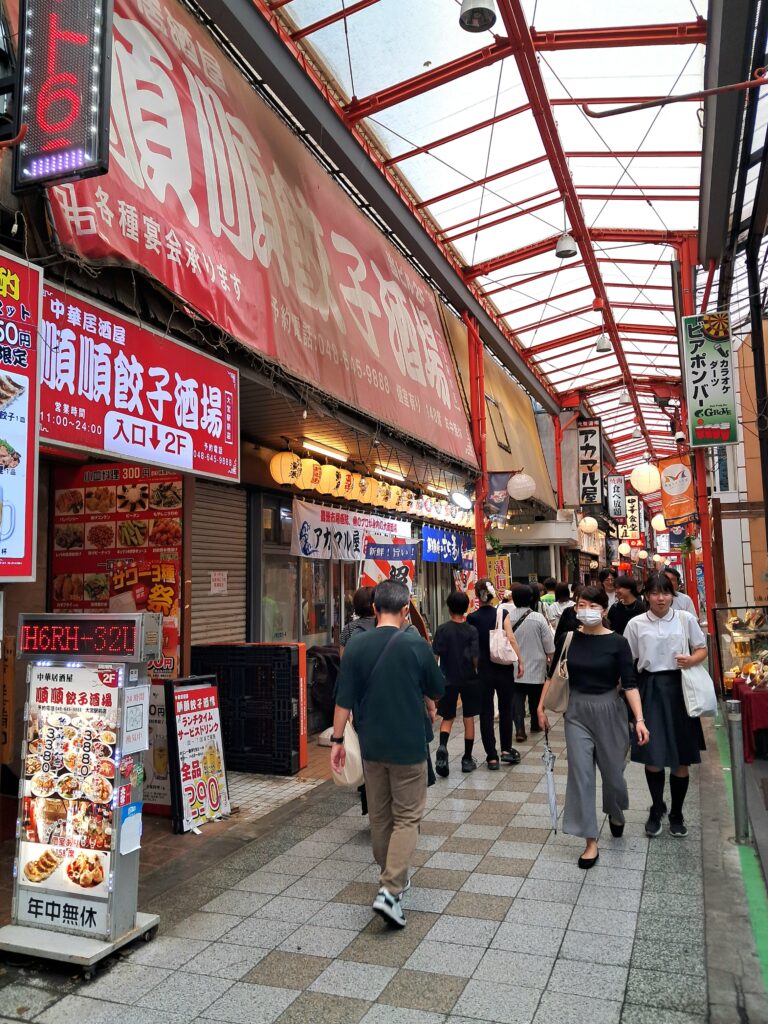
Boasting the commercial hub representing not just Saitama City but the entirety of Saitama Prefecture is Omiya in Saitama City.
It features a massive terminal station with railway networks connecting toward Tokyo and Shinkansen bullet trains supporting access to regional areas, giving the station front a metropolitan feel that could easily belong somewhere in Tokyo.
Drawing people from all over Saitama Prefecture, Omiya is a paradise for urban tourism purposes like gourmet food and shopping.
At the same time, historic sights and nature-rich parks are scattered about, making it a wonderful city that reveals fresh aspects no matter how many times you visit.
Comments