Hello!
These days I’m thoroughly excavating Saitama Prefecture… it’s Nobuyo (@nobuyo5696)!
…Even though I say that, this article isn’t about Saitama Prefecture. Yes… I finally stretched my legs and ventured out! To Tokyo!
So, for my very first Tokyo article, it just had to be a day-trip hot spring (*onsen*).
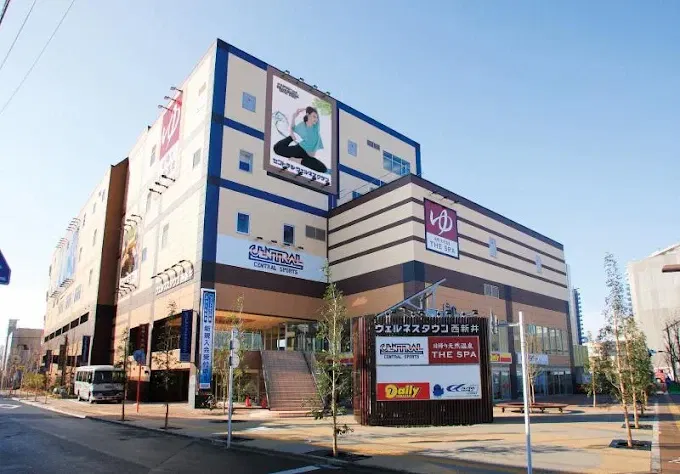
I visited THE SPA Nishiarai, located right in front of Nishiarai Station in Adachi Ward.
THE SPA Nishiarai is an urban hot spring facility built in a perfect location, just a 3-minute walk from the station.
Its biggest selling point is the natural hot spring water gushing from underground, and it seems to have a certain level of popularity as a facility where you can enjoy an *onsen* mood right in the middle of Tokyo.
How will a Tokyo hot spring look through the eyes of Nobuyo, who is completely used to the superb and reasonably priced hot spring facilities scattered all over Saitama…
As always, I’ll be reporting in meticulous detail!
- Basic Information for THE SPA Nishiarai
- An urban spa inside a station-front building. What THE SPA Nishiarai is like!
- THE SPA Nishiarai Opening Hours | Prices | In-House System | Facilities
- An Incredibly Unfair Bath-Swapping System
- THE SPA Nishiarai Spring Quality | Supply System
- THE SPA Nishiarai Crowding Levels | Clientele | Recommended Days & Times to Visit
- Access to THE SPA Nishiarai
- Infiltrating THE SPA Nishiarai!
- Conclusion: Comprehensive Evaluation & Recommended Points
Basic Information for THE SPA Nishiarai
An urban spa inside a station-front building. What THE SPA Nishiarai is like!
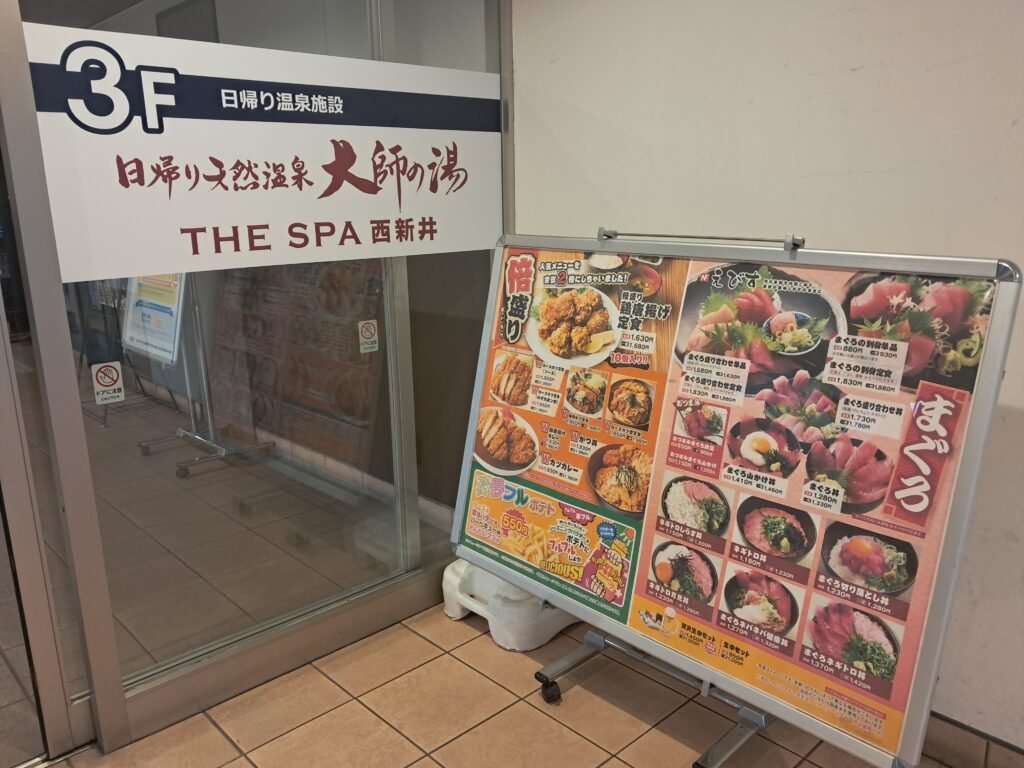
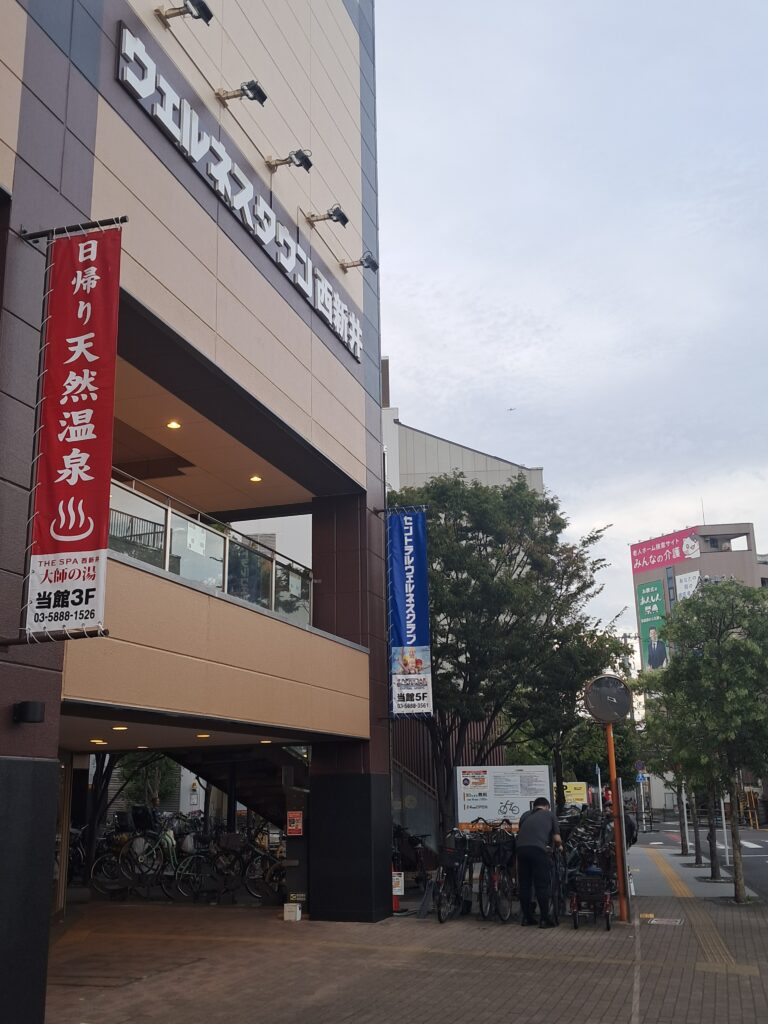
THE SPA Nishiarai’s major strength is its incredibly close-to-the-station location, just a 3-minute walk from the West Exit of Nishiarai Station.
The 3rd and 4th floors of a large building that also houses a sports gym serve as the spa facility.
The main area is the 3rd floor, where you’ll find the reception, restaurant, and main baths.
The 4th floor, up the stairs, is designed almost entirely as a resting space.
It’s surprisingly spacious for being inside a building in Tokyo, but the fact that there are almost no windows and no feeling of openness is, as expected, very typical of the big metropolis of Tokyo.
There is an open-air bath (*rotenburo*), but you still can’t shake the feeling that “I’m inside a building.”
An interesting point is how the atmosphere drastically changes between the 3rd and 4th floors.
While the 3rd floor, including the main baths, gives off a strong vibe of a Heisei-era (1989-2019) super public bath (*super sento*), the 4th floor, which functions as a resting space, has a refined, stylish spa-like atmosphere. It’s quite a noticeable gap.
In addition to the main hot spring, there is a restaurant, stone saunas (*ganbanyoku*), and various massages, making THE SPA Nishiarai a great place to spend a whole day relaxing.
Since there aren’t many hot spring facilities in Tokyo where you can chill out to this extent, it’s quite a precious existence.
THE SPA Nishiarai Opening Hours | Prices | In-House System | Facilities
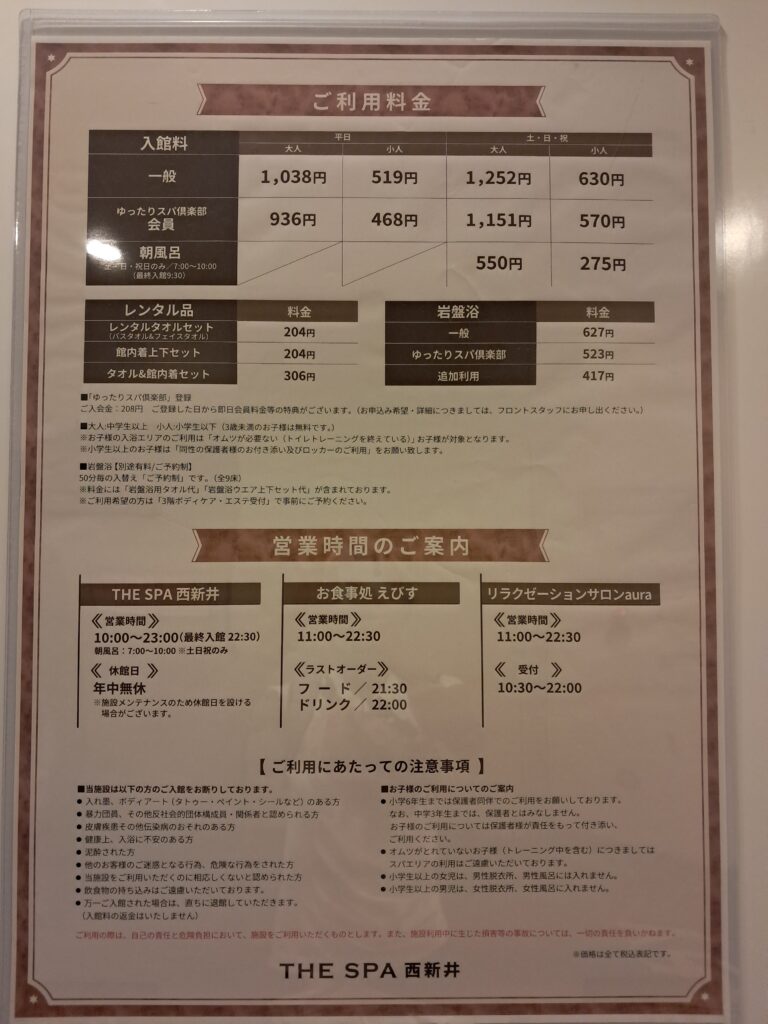
Here is the basic information for THE SPA Nishiarai.
While hot spring facilities in Tokyo sometimes impose time limits, there are no time restrictions here, which is great because you can stay as long as you like.
THE SPA Nishiarai’s usage system is a bit unique.
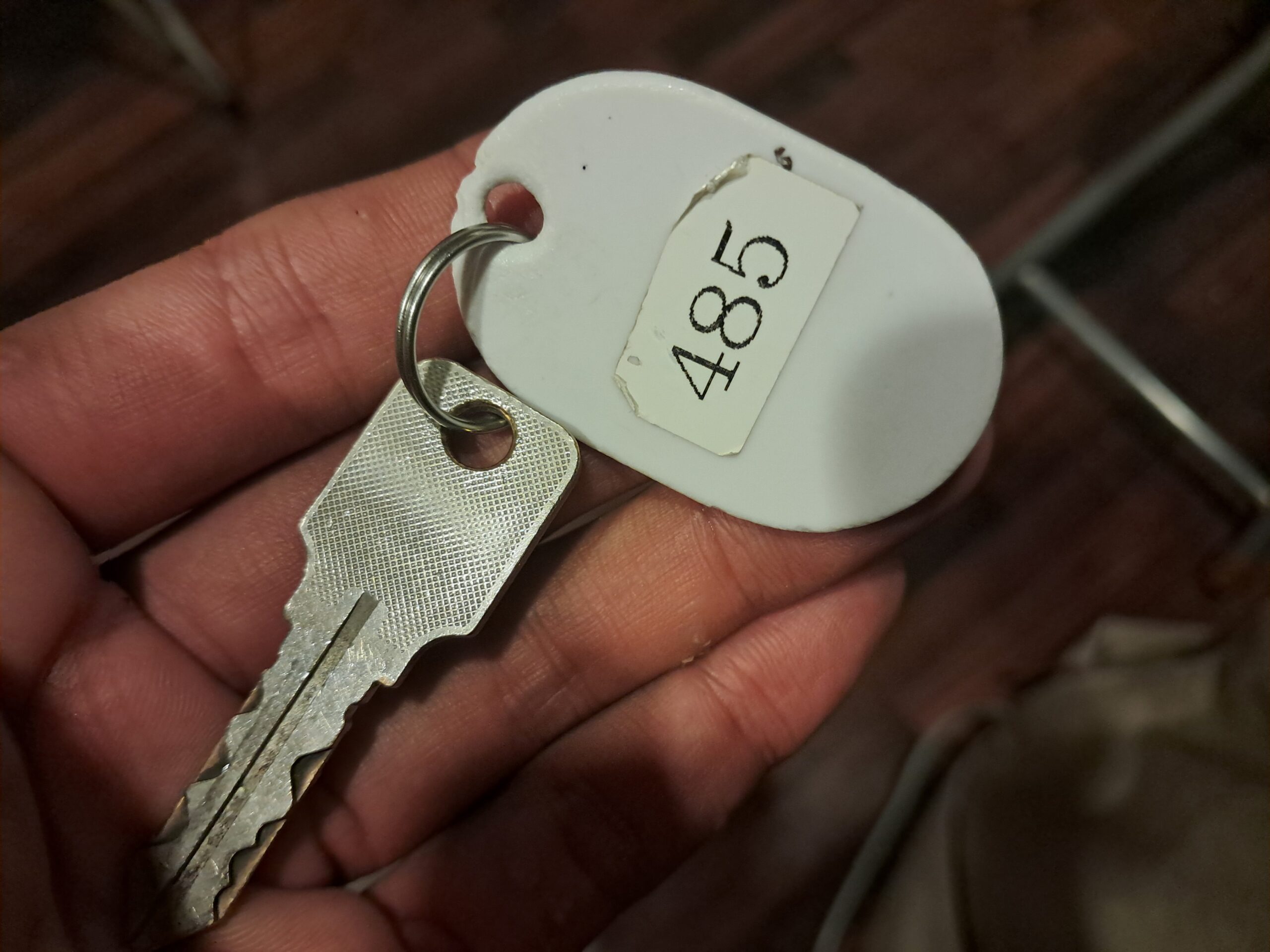
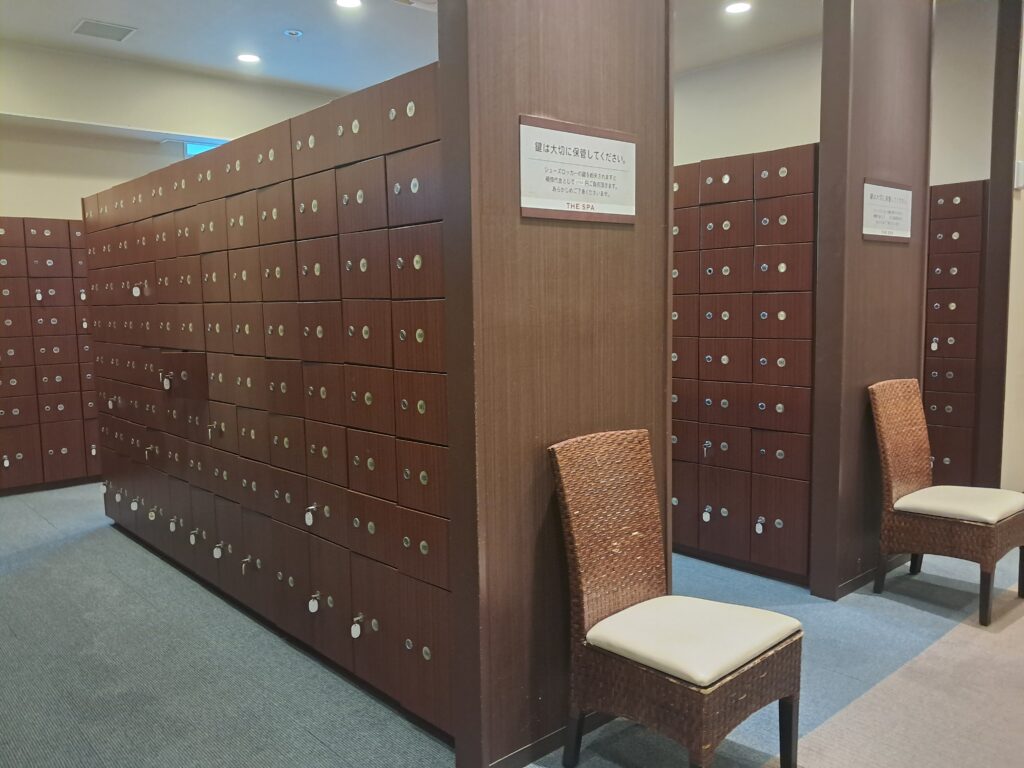
It’s a system where you keep the key to the shoe locker you used upon entering, and at reception, you are handed a wristband for in-house payments.
Furthermore, the key for the locker in the changing room is separate, meaning you must constantly carry around a total of three keys: the shoe locker key, the payment wristband, and the changing room locker key.
Admission fees and food/drink charges are post-paid when you leave, and credit cards are accepted.
They haven’t introduced automatic payment machines or touch-panel ordering in the restaurant, so it retains a somewhat analog feel, which is surprising for Tokyo.
It’s a nice touch that the men’s bath also provides toner and lotion.
On the other hand, there’s a rule prohibiting photography inside the facility, which makes no sense and was a bit of a buzzkill (banning photos in the changing rooms and baths is obvious, but banning photography in the entire facility is baffling).
The 4th-floor resting area looks totally photogenic, and having people take tons of pictures would probably attract more customers, right…?
So, please understand that there are fewer photos than usual in this article.
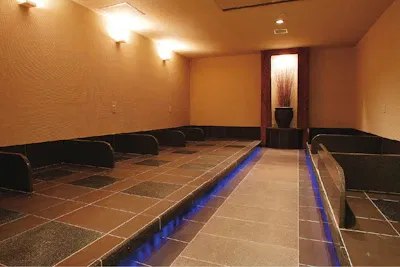
▲THE SPA Nishiarai features a stone sauna (*ganbanyoku*) available for an additional fee.
It’s a stone sauna using germanium ore, and the price is quite reasonable at ¥627 for a 50-minute session.
It comes with a set of towels and stone sauna clothes, making it feel like a good deal.
The germanium ore stone sauna apparently warms your body gently from the inside out via far-infrared effects, which is said to be good for blood circulation and fatigue recovery.
I didn’t use it this time (or rather, I just have no interest in stone saunas), but a fair number of people, primarily female customers, were using it.
The fact that it’s an extra charge on top of the admission fee is a slight bottleneck, but it might be a good option for those who want to get a solid sweat on.
An Incredibly Unfair Bath-Swapping System
There is something I want to complain about regarding THE SPA Nishiarai at maximum volume.
That is the absurdly massive disparity between the two gender-separated baths.
Basically, the men’s bath is a disappointing space with only the single sauna introduced in this article, whereas the women’s bath is an incredibly well-equipped space featuring all that *plus* three saunas, a pot bath (*tsuboyu*) in the open-air area, and a silky bath inside. Huh…??? In Tokyo, a city that preaches so highly about gender equality, what on earth is this disparity???
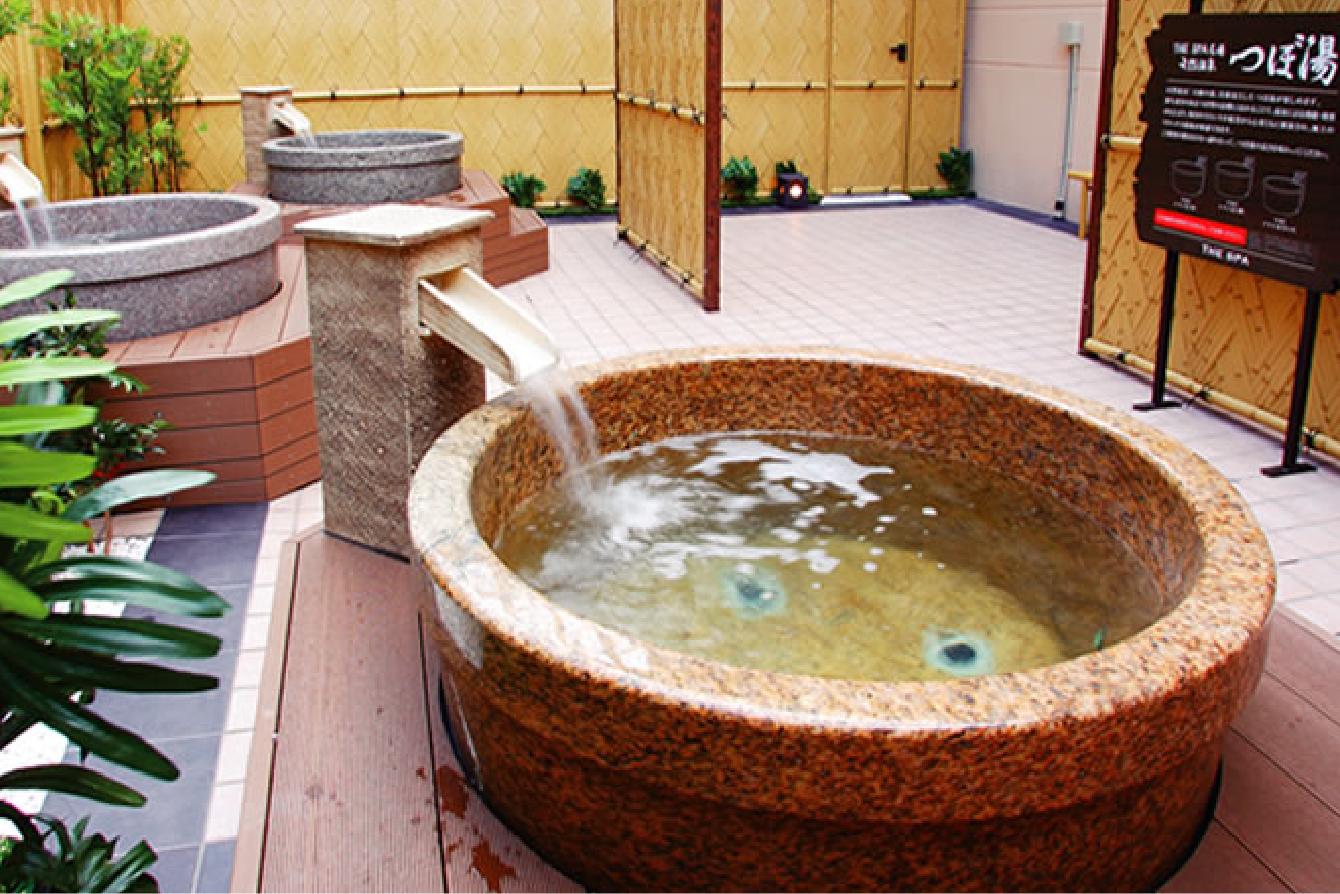
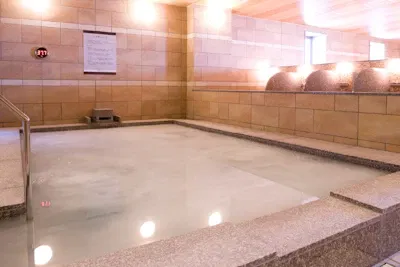
The reason I wrote “basically” is that there’s a system where the men’s and women’s baths are swapped exclusively on days of the month ending in 5 or 0.
In other words, on the 5th, 10th, 15th, 20th, 25th, and 30th of every month, men get the super-deluxe bath, and women get the disappointing bath.
But flip that around, and it means for the majority of the month, the men’s side uses a lame bath with just one yellow-clay sauna, while the women’s side gets to use a heavenly bath equipped with three types of saunas (yellow-clay + steam mist + salt), plus a pot bath and a silky bath.
From a sauna lover’s perspective, there seems to be a loud consensus that “the women’s side is overwhelmingly the jackpot,” and well, obviously, if you’re paying the exact same price, you’d want the bath with way more features.
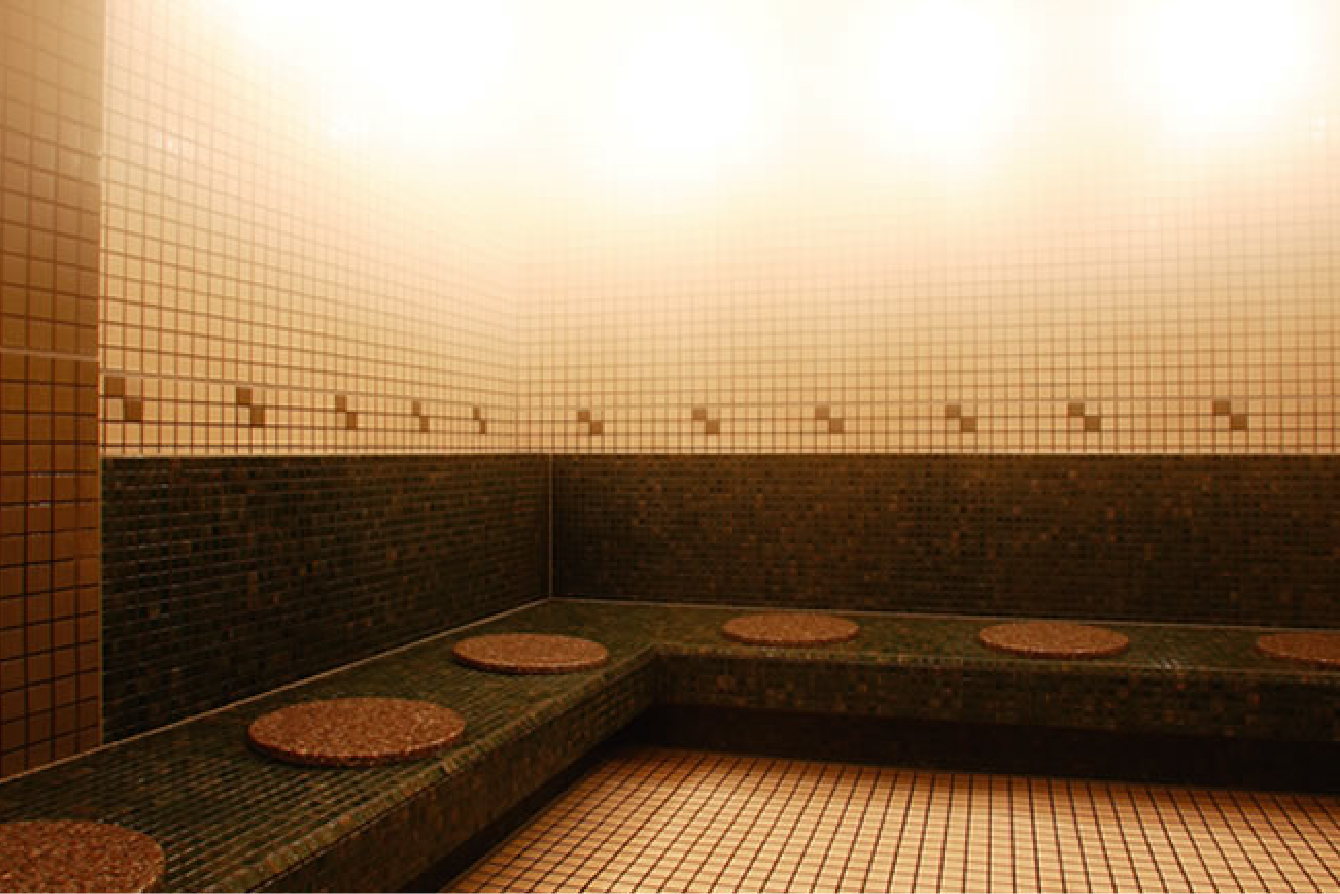
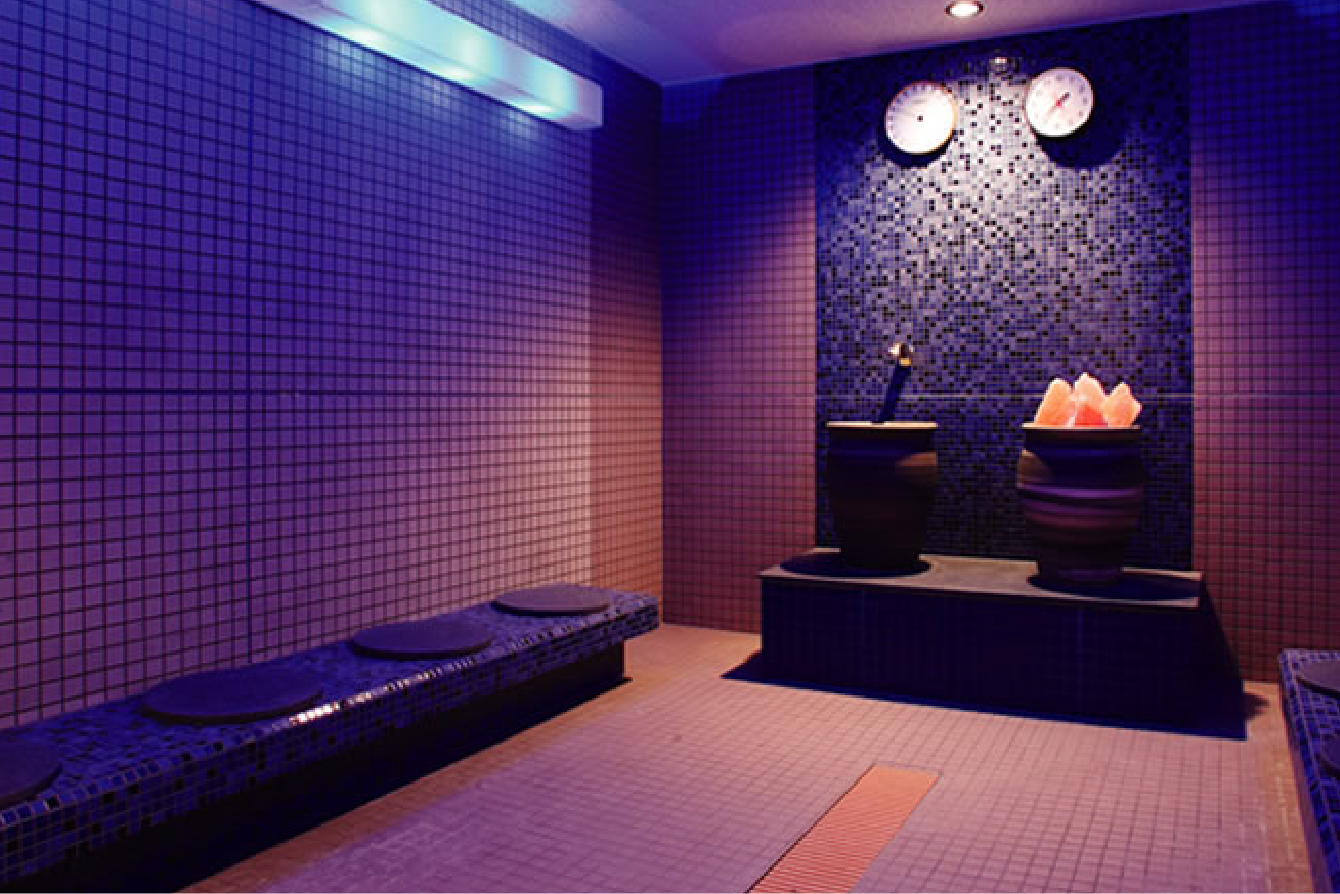
Looking at it this way, the two baths are so completely different that your level of satisfaction will drastically change depending on which bath you get stuck with.
I’m telling you for your own good: I highly recommend timing your visit to target the days when your gender gets the heavenly bath.
THE SPA Nishiarai Spring Quality | Supply System
The spring quality of THE SPA Nishiarai is a sodium-chloride strong salt hot spring.
It’s a natural hot spring gushing from 1,500 meters underground, and facilities in Tokyo that actually use natural hot spring water in their baths are surprisingly rare and precious.
The water is a transparent brownish color, characterized by an insanely strong salt content.
Its saltiness is basically seawater, to the point where sunburned spots will sting.
Personally, I’m not a big fan of strong salt springs that leave your hair feeling stiff and crunchy, so it honestly wasn’t my preferred type of water, but people who like it will probably love it.
The cozy warming sensation that penetrates the body and the moisturizing feeling that clings to the skin are a bit weak, and if you ignore the saltiness, the water had a surprisingly unquirky, smooth texture.
The disappointing part is that all the bathtubs using THE SPA Nishiarai’s hot spring water are circulation-type, chlorinated, heated, and diluted with added water.
I can somewhat understand chlorination and heating, but I’m not really on board with adding water to dilute the hot spring… I found myself thinking, shouldn’t there be at least one tub flowing with undiluted hot spring water?
THE SPA Nishiarai Crowding Levels | Clientele | Recommended Days & Times to Visit
I visited THE SPA Nishiarai just after 5:00 PM on a Monday.
When I arrived, there were more people than I expected, but not enough to call it crowded, and I had no trouble finding my own space.
After that, the crowd steadily thinned out from around 6:00 PM, and by 7:00 PM—which is peak time for hot spring facilities in Saitama—it was completely empty.
After 8:00 PM, high school groups and solo guests increased slightly, and the place regained a bit of liveliness until around 10:00 PM.
For that reason, the relaxed vibe on a weekday—so much so that you wouldn’t think you’re in Tokyo—was a huge plus.
Rumor has it that it’s relatively uncrowded even on weekends, so it might be a hidden gem for people who hate crowds.
THE SPA Nishiarai’s main demographic is men in their 50s and 60s. Young solo male visitors are sparse, and there are practically no families with children.
Perhaps because of the stone sauna, there were many female friends and young solo female visitors, which is a major difference from the clientele at Saitama hot springs (as young solo female visitors are extremely rare at Saitama facilities).
Although there are almost no warning posters inside the facility, my impression was that the customers’ manners weren’t bad considering.
However, in the men’s bath, there were a lot of, how should I say… grubby-looking old guys… (Sorry for judging by appearances, but since it’s a public bath, I do worry about hygiene). There was even a guy talking to himself non-stop, which made me think, “Give me a break…” and I felt like I was immediately receiving my baptism into Adachi Ward.
On the other hand, because there are very few families with children, the facility is basically quiet, which is fantastic.
However, it seems there’s a kids’ sports class on the same 4th floor as the resting space, and what’s more, the resting space and the sports class share an open-atrium-like structure. Hearing the endless distant shouts of kids working hard at sports was quite annoying. Freakin’ build a wall already.
Access to THE SPA Nishiarai
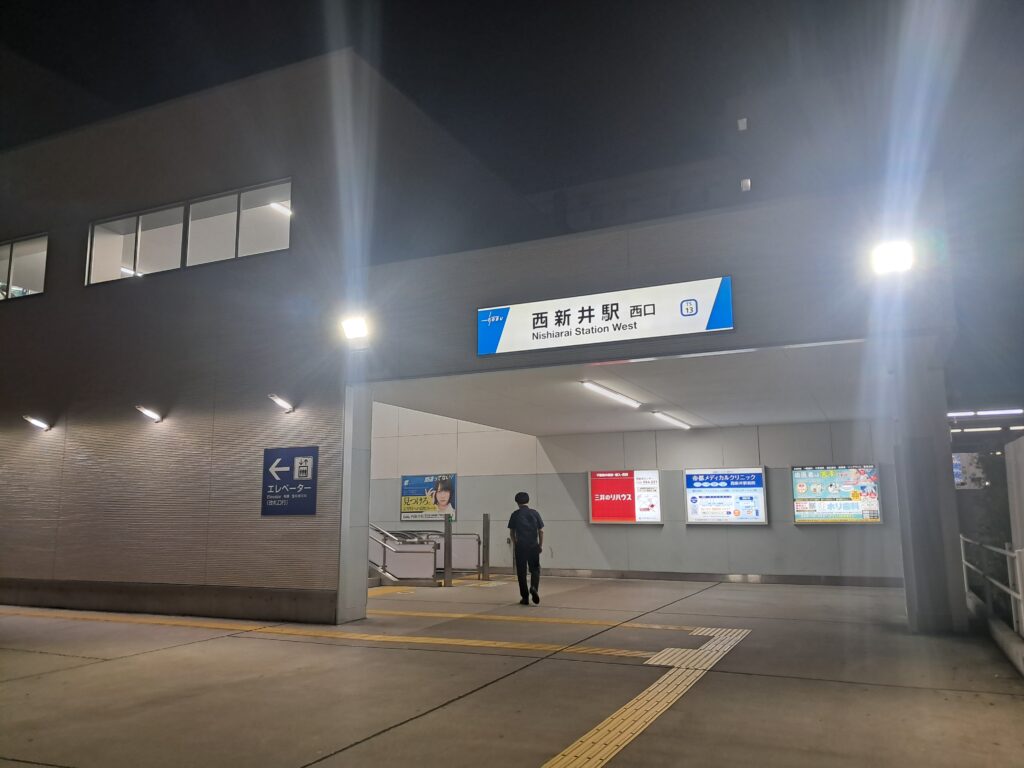
The closest station to THE SPA Nishiarai is Nishiarai Station on the Tobu Skytree Line.
It’s an indisputably great location, just a 3-minute walk from the West Exit of Nishiarai Station, meaning absolutely zero inconvenience regarding access.
▶ Tokyo Station ~ Nishiarai Station: Approx. 30-40 min via Tokyo Metro Hibiya Line to Tobu Skytree Line | ¥390~
▶ Shinjuku Station ~ Nishiarai Station: Approx. 40-50 min via Tokyo Metro to Tobu Skytree Line | ¥450~
▶ Asakusa Station ~ Nishiarai Station: Approx. 15-20 min via Tobu Skytree Line | ¥210~
If coming by car, you can use the parking lot in the building where THE SPA Nishiarai is located.
Facility users receive a 2-hour free parking ticket upon leaving, but be aware that it becomes paid after 2 hours.
Since it’s so close to the station, I think there is little merit in going out of your way to drive there.
Infiltrating THE SPA Nishiarai!
Now that we generally know what kind of place it is, off to the hot springs…!
I’ll write frankly about my actual impressions after taking a bath, down to the parts where I thought, “It would’ve been better if they did this…”
Reception to Hall
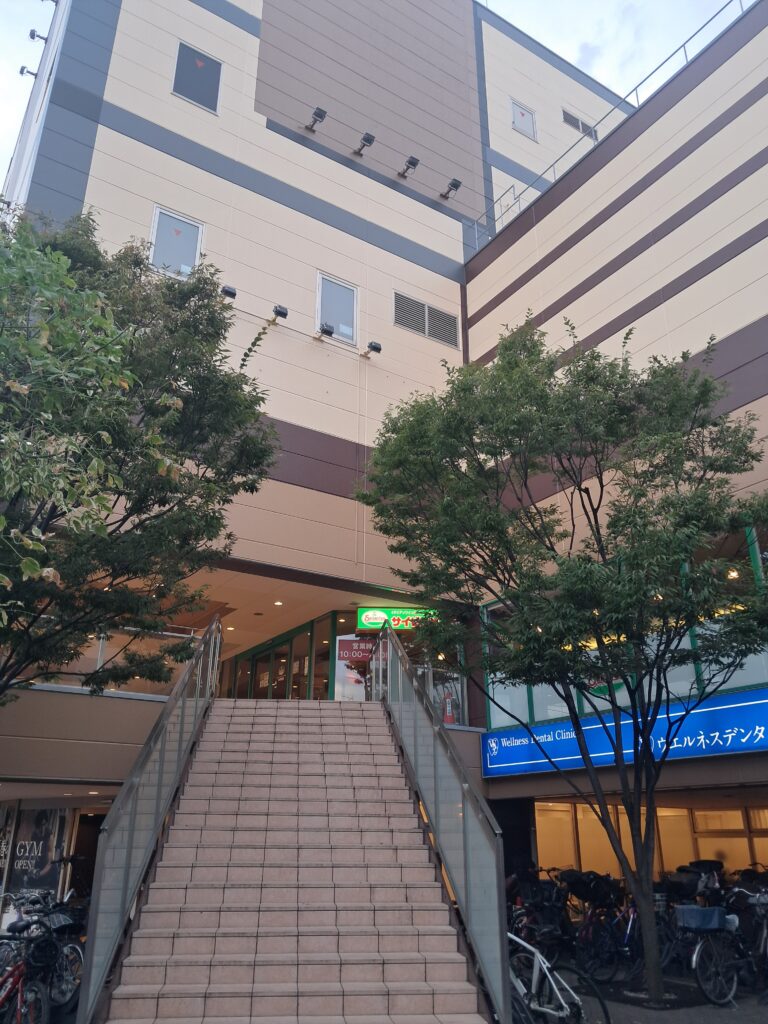
The building housing THE SPA Nishiarai is large and exudes a strong Tokyo vibe.
Access to the reception on the 3rd floor is via elevator, but the elevator’s location was slightly hard to find.
Upon arriving at the 3rd floor, you’ll find a reception radiating an intense Heisei-era vibe (you’ll know what I mean if you go).
The staff’s friendliness isn’t bad, and they interact with you normally, but I couldn’t help noticing that overall, their voices are quiet and lacking in energy. They also didn’t explain how to use the facility unless I asked, which felt a bit unwelcoming (is this just how the big city of Tokyo is?).
The Main Bath Was Honestly Disappointing…
An Open-Air Bath Area Covered by a Roof
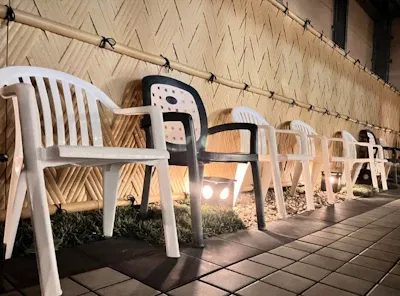
My first impression of THE SPA Nishiarai’s open-air area was, “Wait… it’s tiny…” (or rather, I literally said that out loud).
If I had to describe it, it’s like “a little terrace space inside a building,” and because half of the overhead space is covered by a roof and the other half by bamboo blinds, there’s almost zero sense of openness.
In a bleak space with hardly any plants, I felt disappointed, thinking, “Even though it’s an open-air bath, it somehow feels like I’m indoors…”
…Well, maybe I just felt that way even more because I’m completely used to the “vast grounds, lots of bathtubs, and blue sky spreading overhead” often found in Saitama’s open-air areas.
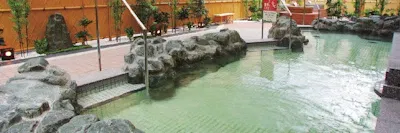
The open-air area has only two things: one large bathtub using hot spring water covered by bamboo blinds, and a reclining bath (*ne-yu*) completely covered by a roof. This means there’s practically only one tub you can soak in, which feels quite lonely.
On the other hand, it’s well-equipped with cooling-down chairs, so I had no trouble finding a space to rest.
The lighting in the open-air area is solely indirect lighting, so it gets extremely dark after sunset, but personally, I was able to relax because of it, so it works for me.
There’s no TV, and it wasn’t crowded, so the quite tranquil atmosphere was also nice.
(https://www.central.co.jp/thespa/nishiarai/)
The main (or rather, only) tub in the open-air area is the 36.9°C hot spring bath.
As you can tell from the temperature, it’s incredibly lukewarm. It’s fine in the summer because you can stay in for a long time, but I bet it would be absolutely freezing in the winter (maybe they heat it more in winter?).
The water is transparent brownish and has a smooth texture. There is almost no scent, and you barely smell the chlorine either.
The ridiculously strong salt content is just like seawater, so it might hurt if you have scratches.
It seems the women’s open-air bath is built somewhat like a rock bath (a nice touch!), but the men’s bath is a tiled tub with a Showa-era public bath vibe.
It has a retro feel, but absolutely no traditional hot spring charm.
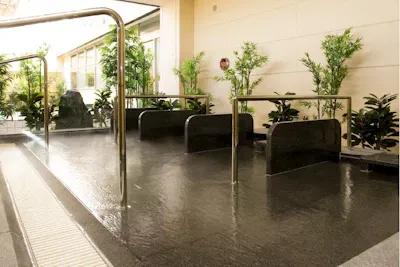
The other feature in the open-air area is the reclining bath that uses hot spring water.
This is 37.0°C and has four spaces where you can lie down and relax, but the drawback is that both the pillow and the backrest are solid stone, making your body hurt.
This reclining bath isn’t the type where you lie in a shallow pool of water, but rather a type where water trickles down from above your head onto your back.
However, the volume of trickling water is so low that it just felt like “I’m kinda just lying on top of a warm stone,” so it seems like it would be incredibly cold in the winter.
The Attraction Baths Are Pretty Good! The Indoor Bath Area
THE SPA Nishiarai’s indoor bath area only features one hot spring tub, attraction baths, and a cold water bath.
Half of the floor space is dedicated to the shower corner.
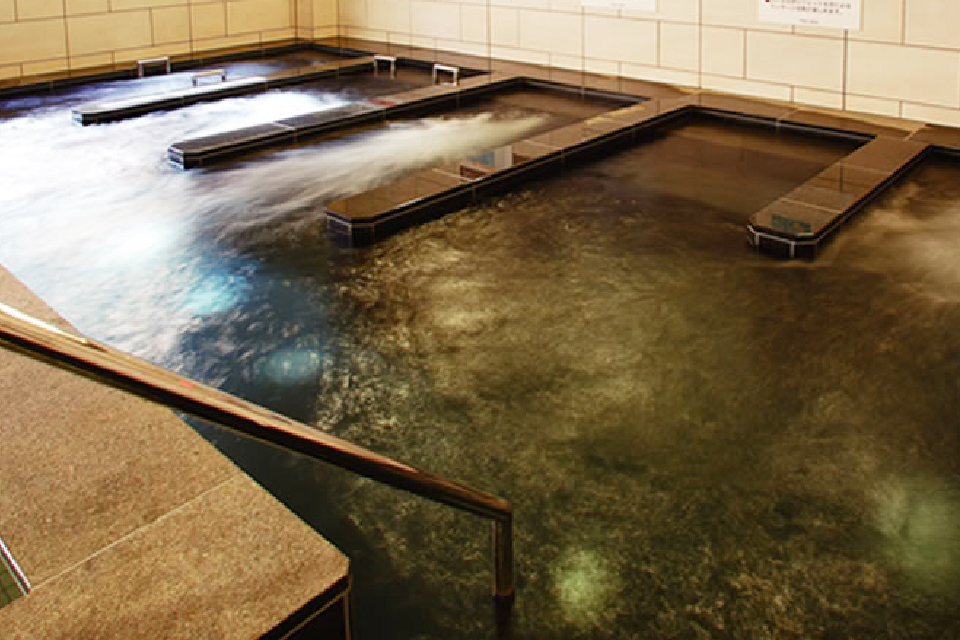
▲The attraction baths are divided into five spaces, all with different types of jets like bubble baths and massage baths, making you want to conquer them all.
The water isn’t from the hot spring, but rather heated tap water mixed with bath salts that change periodically; this time it was a “Cosmos Scented Bath.” It smelled pretty nice.
Among the five attraction baths, my personal favorite was the floating bath.
By aiming a powerful jet at your stomach, you can experience a floating sensation where your body literally rises to the surface of the water, making me feel like a “flying Superman.”
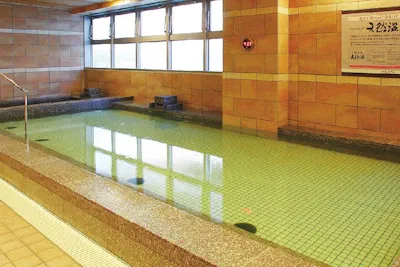
The indoor hot spring bath sits at 39.5°C, higher than the open-air bath, so you get a much stronger sense that you are actually soaking in a hot spring.
The water is clean with almost no scum, and personally, I prefer water around this temperature.
It seems less popular compared to the open-air bath, so it was relatively empty, which ironically allowed me to take my time and relax.
There are about 30 shower stations installed, featuring a push-button system that dispenses water for a set time.
Having every shower semi-independent and separated from its neighbor by a partition wall is a big win.
The Sauna’s Temperature and Scent Are Both Meh…
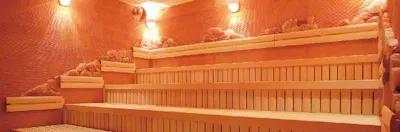
The yellow-clay sauna, which is the sole sauna in the men’s bath, has 4 tiers and is spacious enough to easily fit 40 people.
There’s a TV in the center, and what looks like rock salt installed on the walls, giving off a “I don’t really get it, but it seems good for you” vibe.
Perhaps because it’s separated from the indoor bath by just a single door, making it easy for heat to escape, the room temperature inside the sauna fluctuates a bit around 70°C to 80°C.
There’s no *löyly* (steam generation) or anything, just a “veteran sauna facility” vibe, and it was disappointing that it wasn’t very hot.
Rather than the half-hearted temperature for a sauna, what really bothered me was the scent inside the room.
A sour, unpleasant smell (that typical pool changing room smell) filled the room, making it quite uncomfortable.
The cause of this foul odor is probably because there are no towels laid on the floor, but rather a mesh mat like the ones used on pool floors.
While it is a sauna where you sit using your own individual sauna mat, I assume the sweat dripping off the sauna mats falls through the gaps in the mesh straight to the floor, where it gets heated up just like that (I’m starting to feel sick just writing this…).
It must be quite difficult to clean those mesh mats properly, but the massive problem is that I never once saw anyone clean the sauna during my 4-hour stay.
Wait… don’t tell me they only clean it after closing…? No, surely not! This is Tokyo, a city with high hygiene standards!!! (faltering words)
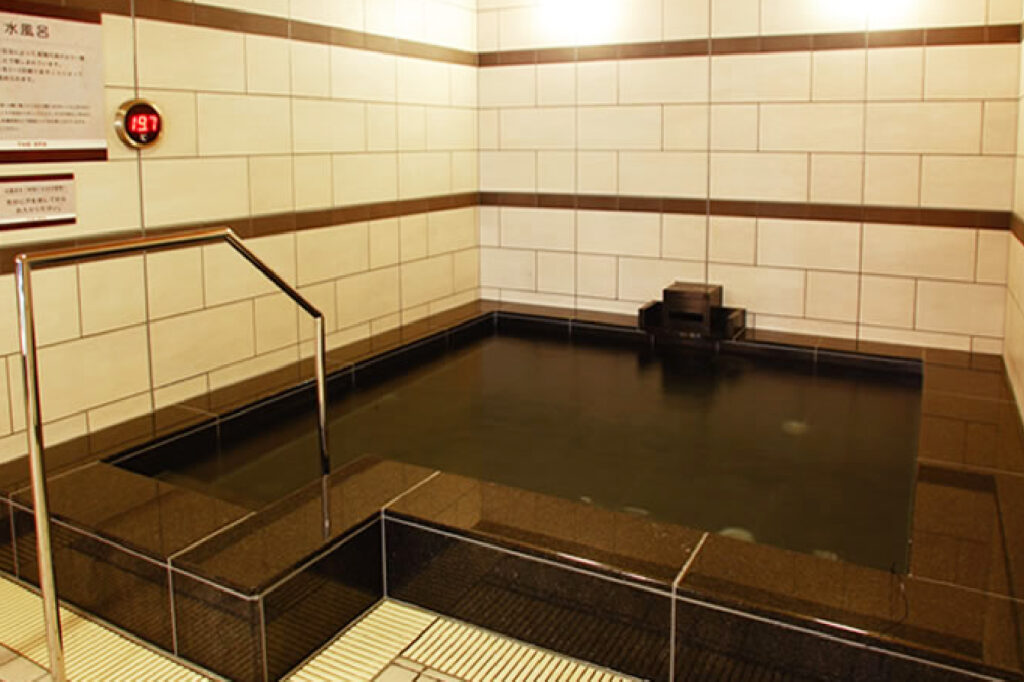
The cold water bath located right by the sauna exit sits at 17°C with a capacity of about 6 people.
It’s not bone-chillingly icy, but you can cool down thoroughly, so it works perfectly fine.
There are no strict rules like banning diving or washing your face, so being able to use it somewhat freely was a nice point.
Other Facilities (Resting Space | Dining Area, etc.)
THE SPA Nishiarai’s Biggest Selling Point! The Resting Space
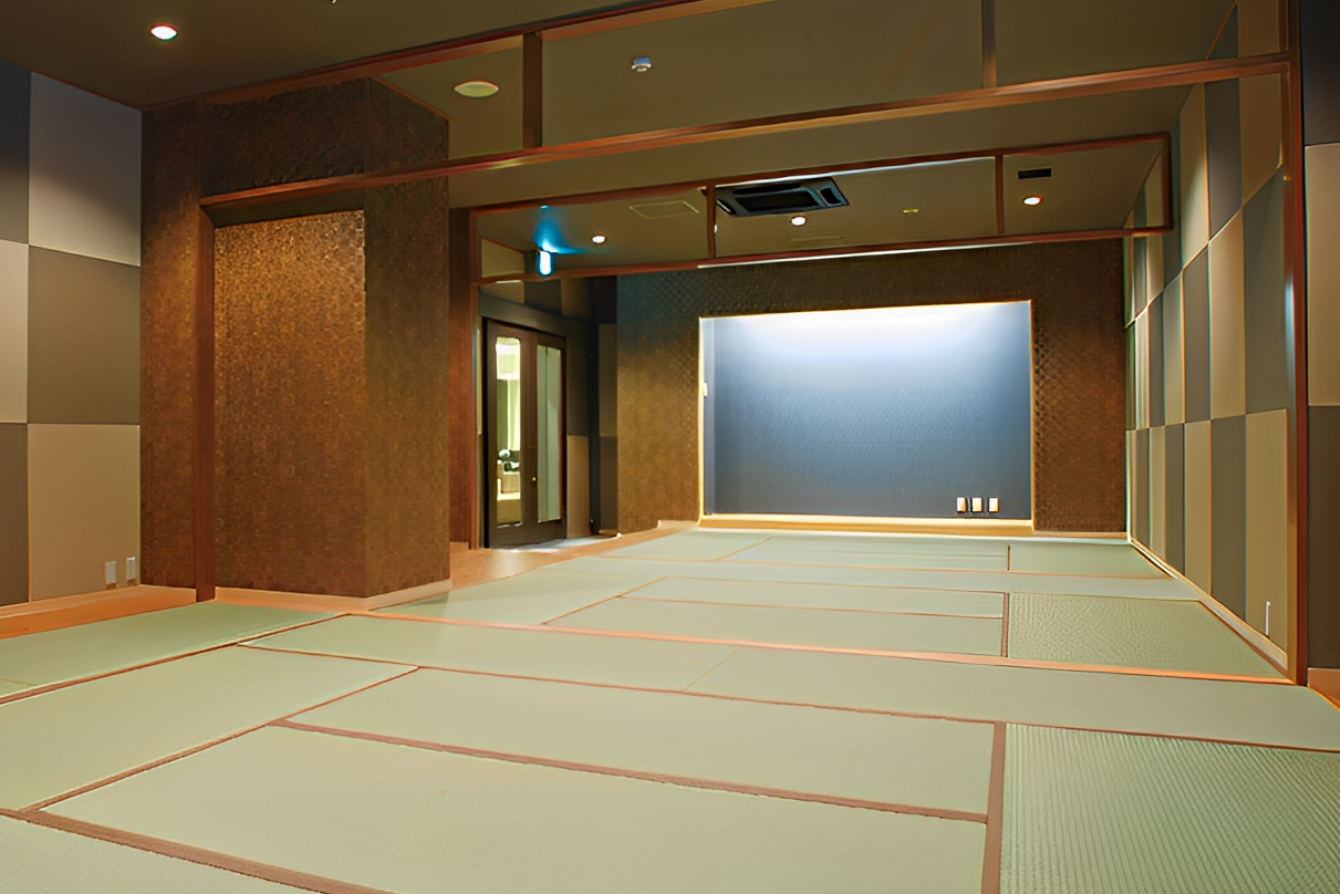
Something I personally rated as awesome at THE SPA Nishiarai is the resting space that spans the entire 4th floor.
A complete turnaround from the 3rd floor that reeks of Heisei-era super sento vibes, the 4th floor is a relaxing space that makes you admire it and say, “Now THIS is an urban spa facility!” I think this is the facility’s biggest selling point, but for some reason, it’s not heavily promoted, which is baffling.
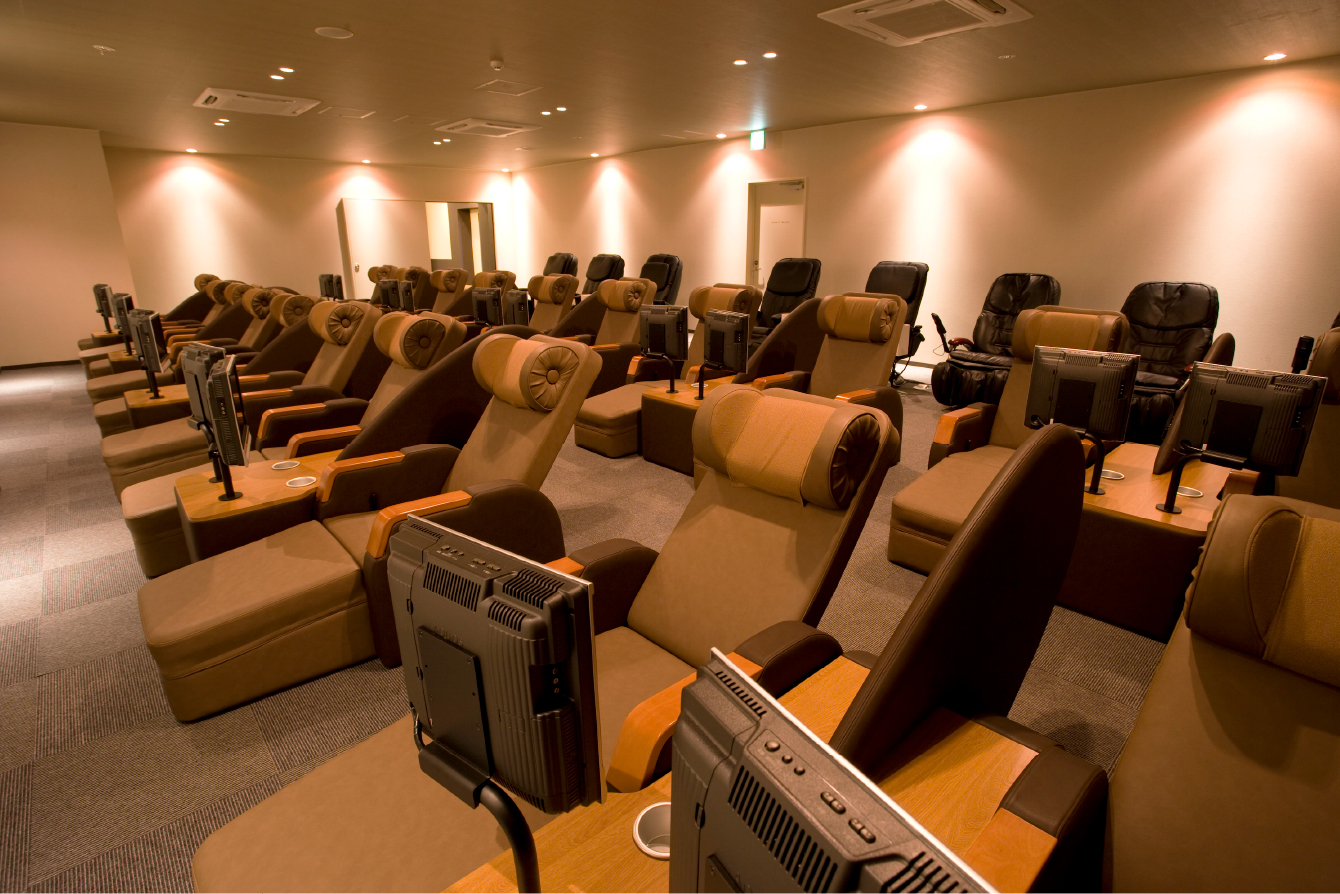
The resting space is divided into several zones, including a room lined with reclining chairs, a hall with sofas, a coworking space with desks, a lie-down area for people who want a solid sleep… allowing you to chill out in a space that fits your preference.
The interior design is top-notch, creating a calm and spacious atmosphere with warm lighting set against all-white walls.
The generous supply of manga is an irresistible point for fans. I saw many people renting the facility wear and staying for hours, completely absorbed in reading manga.
In a word, my impression is that this resting space significantly compensates for the extreme mediocrity of the bath quality.
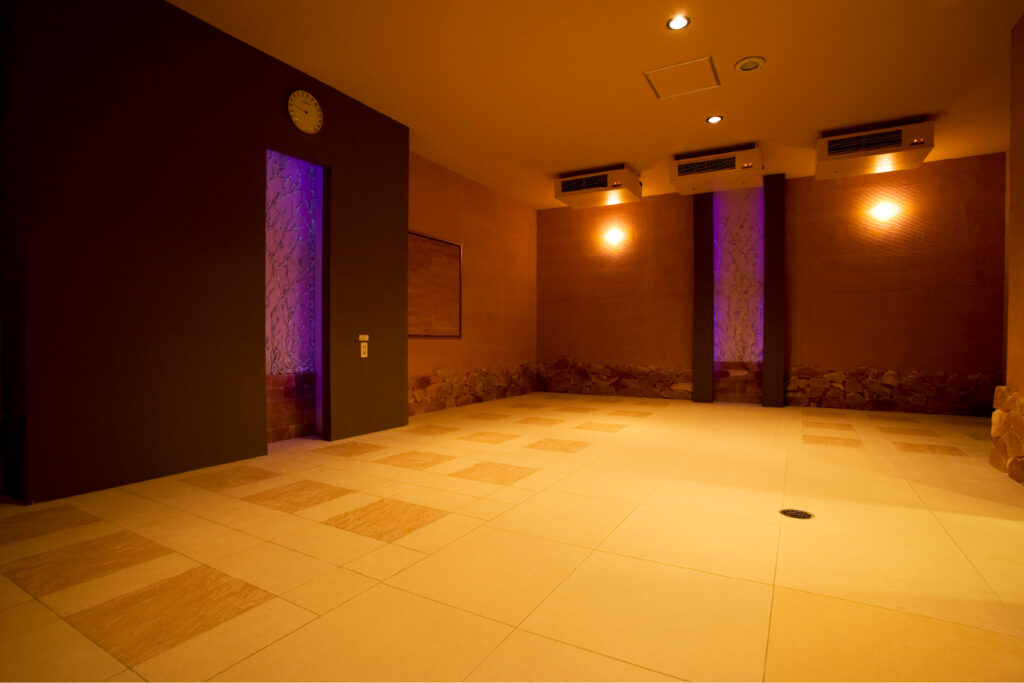
▲Within the 4th-floor resting space, something a bit unique is the Coral Ondol Room.
It’s a Korean Ondol-style room using underfloor heating, making both the floor and the air cozily warm.
Coral (the pretty stuff from the sea) is used on the walls, which apparently emits negative ions and has the effect of boosting the body’s healing abilities.
There are beanbag chairs scattered inside, letting you sprawl out and relax in a warm environment.
A Restaurant Pushing Seafood
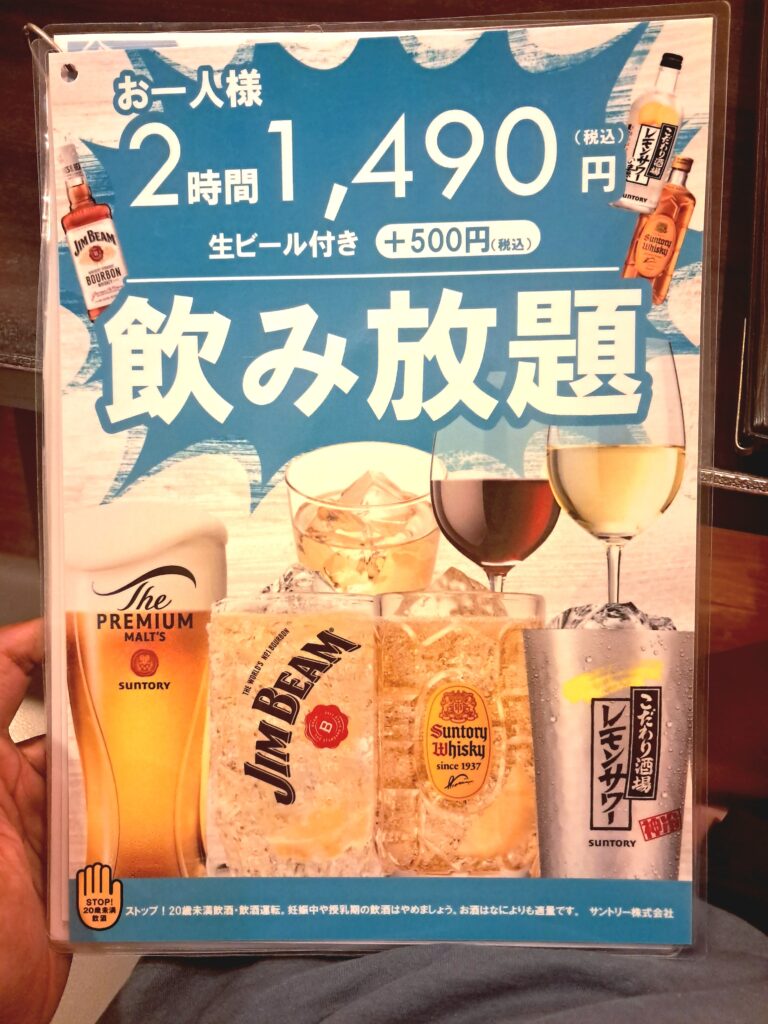
Located right past the 3rd-floor reception is THE SPA Nishiarai’s restaurant.
The inside is much more spacious than it looks from the outside, featuring only table seating with no tatami mats or counter seats.
The restaurant staff’s attitude isn’t bad, but their voices are so quiet you can barely understand what they’re saying (or rather, the employees here are entirely too quiet overall).
There was no greeting like “Welcome!” either, leaving first-time customers who don’t know the system standing frozen, wondering, “Is it okay if I just sit anywhere…?”
Unusually for a day-trip hot spring restaurant like this, it’s a full-service setup where staff take your order and serve your food, which is a great touch.
There are no tablets installed; it’s the type where you look at a paper menu to order.
What bothered me was that it was practically empty despite it being the dinner peak time.
Even granting that there weren’t that many people in the facility to begin with, having only three other groups of customers besides me at 8:00 PM is quite deserted. It makes me worry, “Are you guys doing okay?”
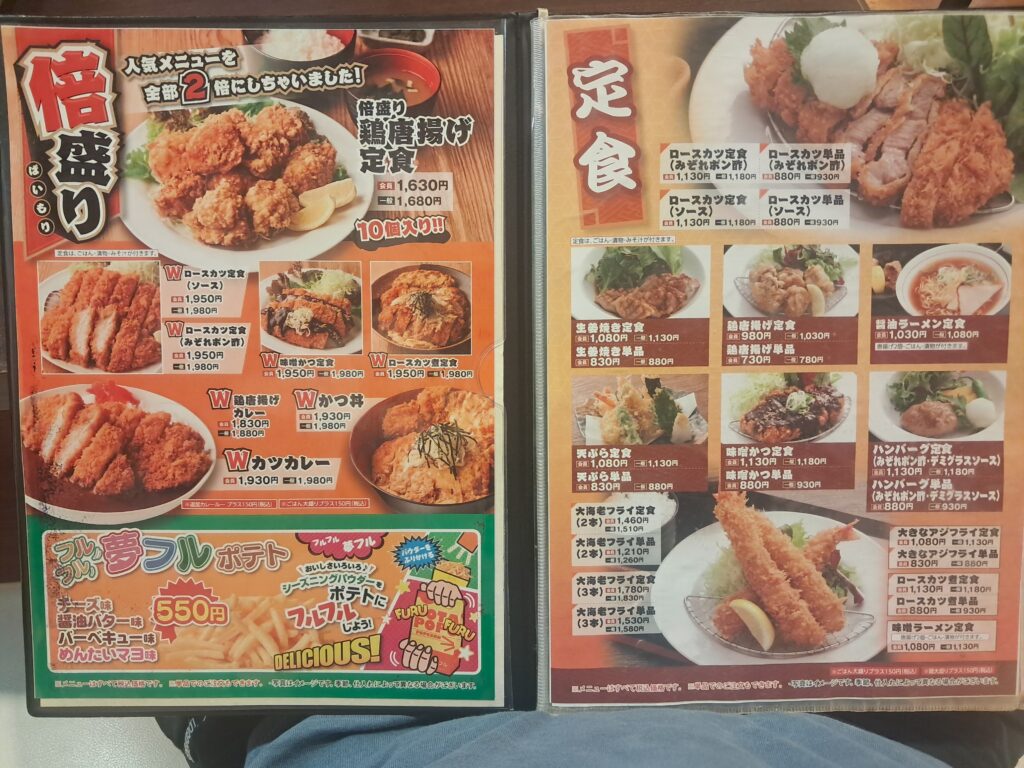
The restaurant’s menu covers all the standard day-trip hot spring facility staples.
A standout feature is that it has an awful lot of seafood options, but maybe that’s because Adachi Fish Market is nearby?
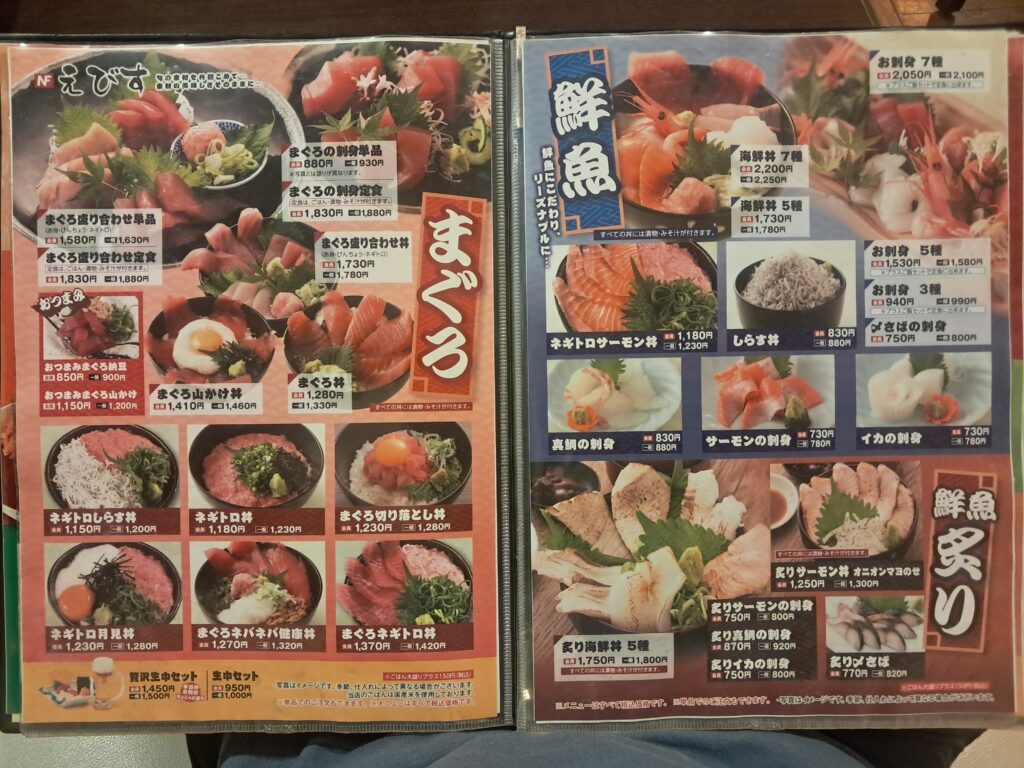
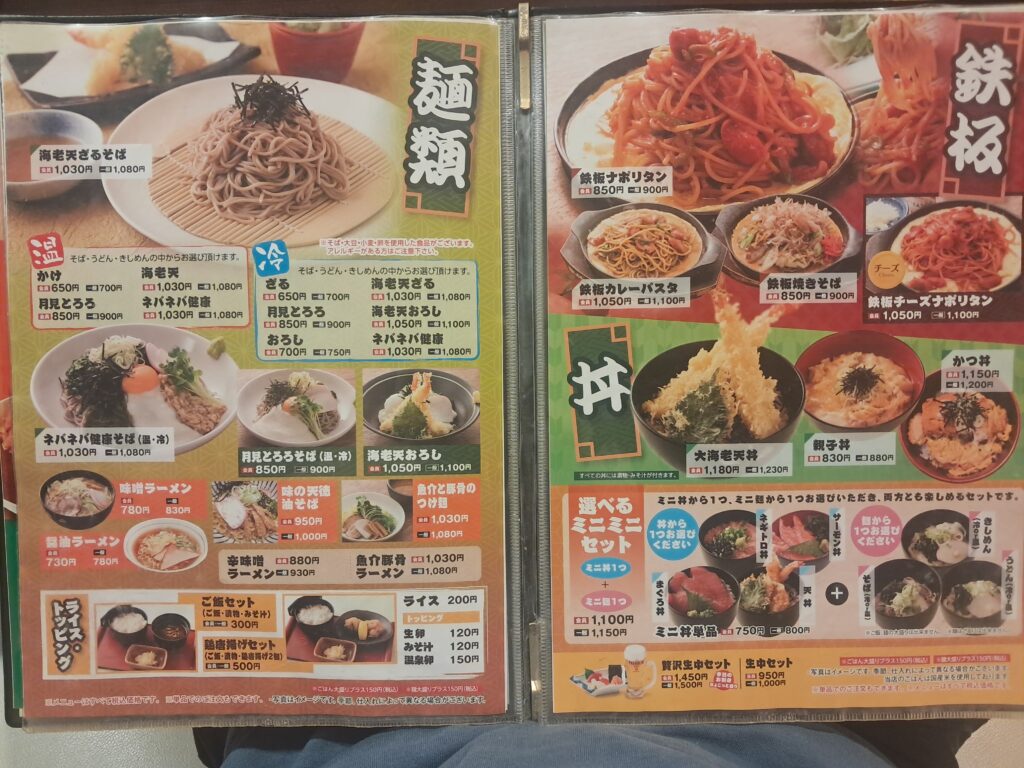
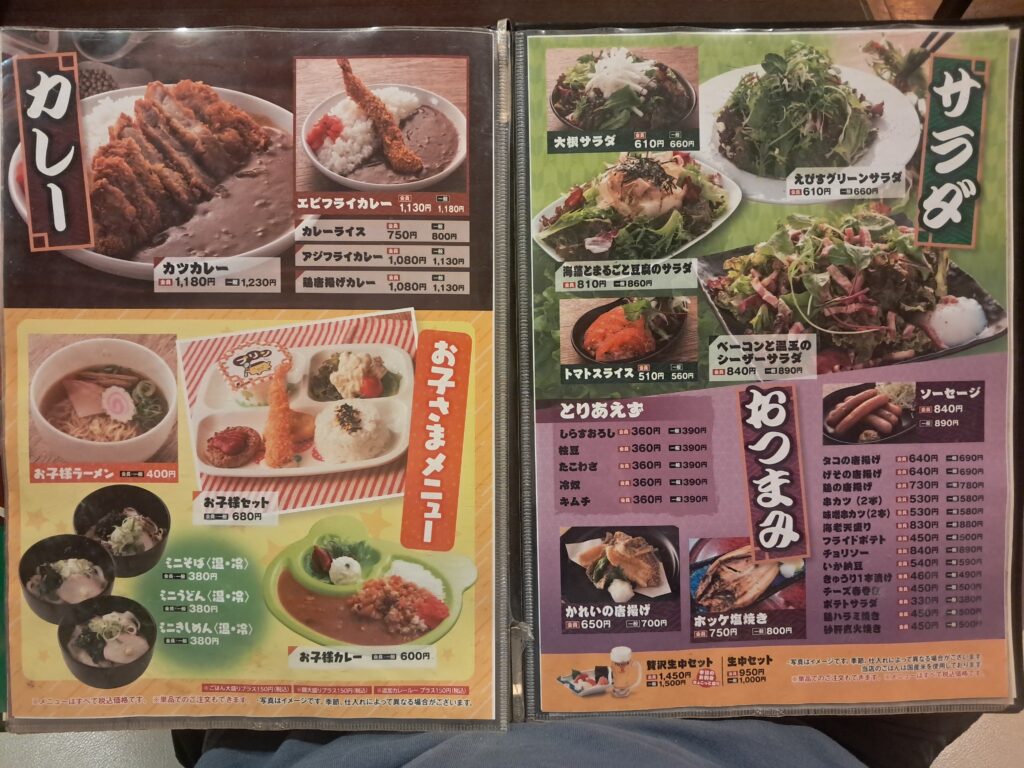
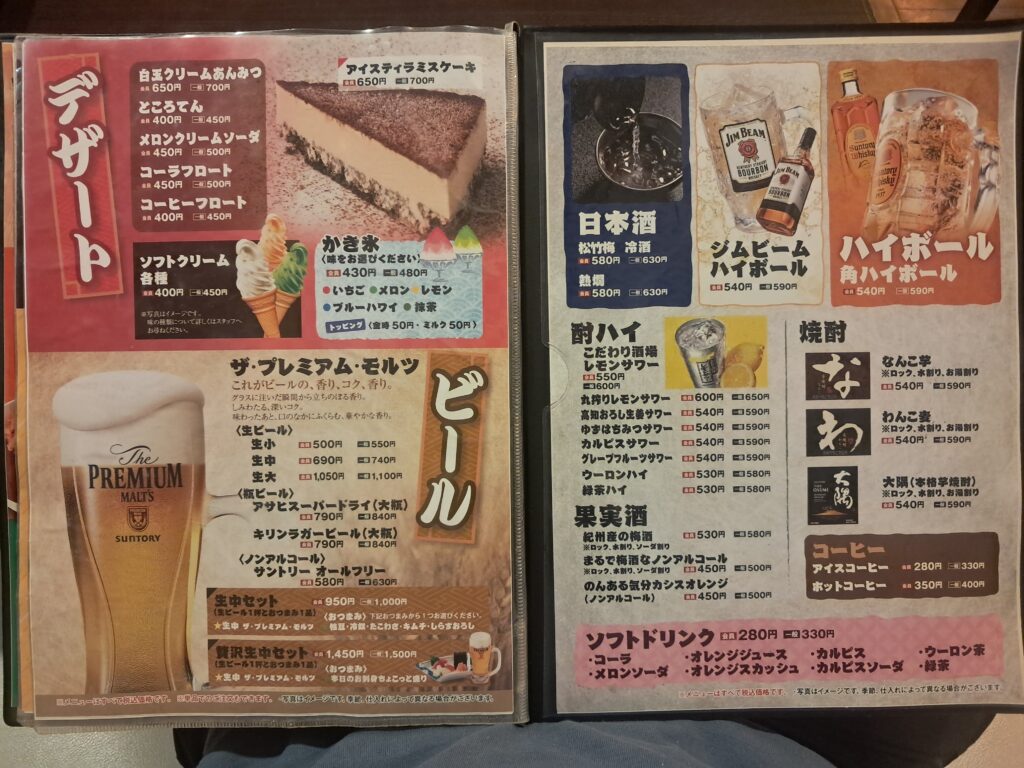
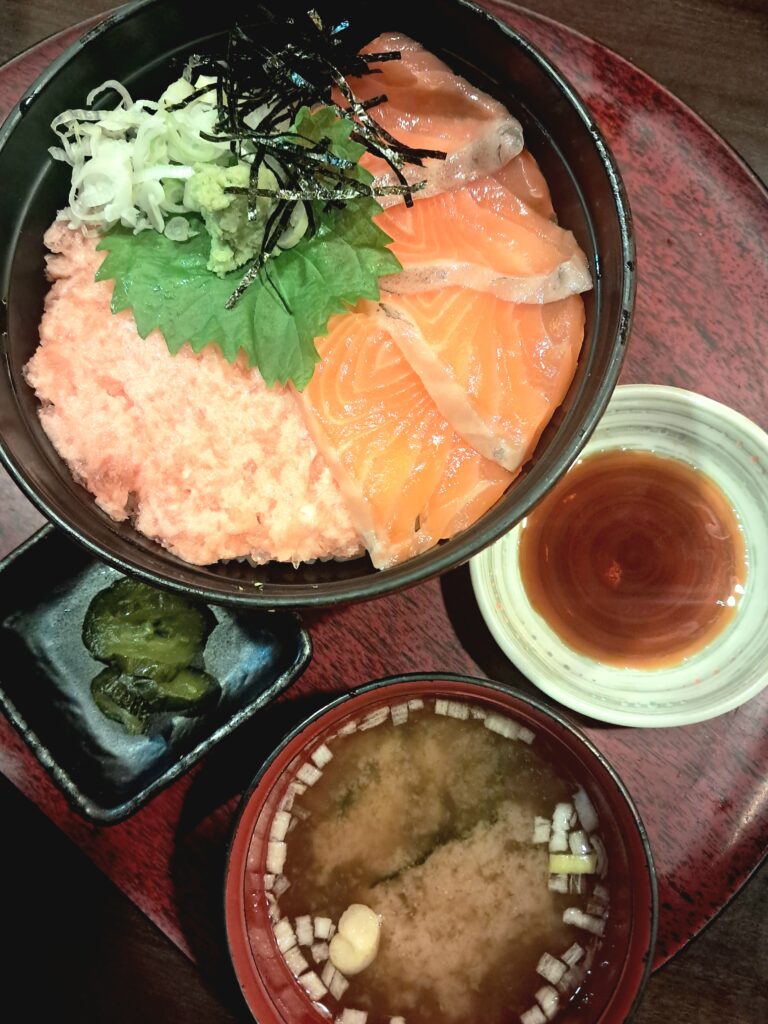
So, deciding to eat what seemed to be their top recommendation, seafood, here is what I ordered: The Negitoro Salmon Rice Bowl.
I was surprised by the demon-like speed of its arrival—just about 3 minutes after ordering—but well, they’re just putting fish on top of rice, so I guess it makes sense. ▼
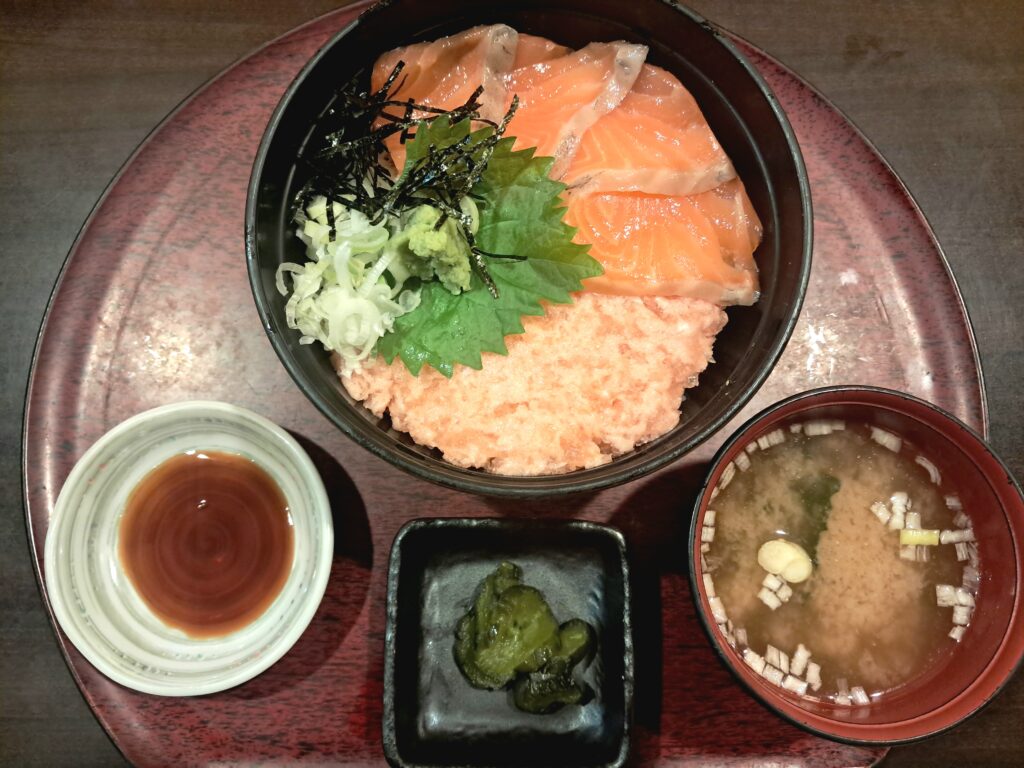
What surprised me was that it tasted quite good.
For a restaurant attached to a hot spring facility and not a specialty shop, I thought the quality of the fish was remarkably high.
Naturally, the negitoro (minced tuna with green onion), which rarely misses the mark, was good, but the salmon also had practically zero fishy smell.
I could properly taste that melt-in-your-mouth texture and rich fatty flavor, the rice wasn’t cooked poorly either, and overall I was quite satisfied.
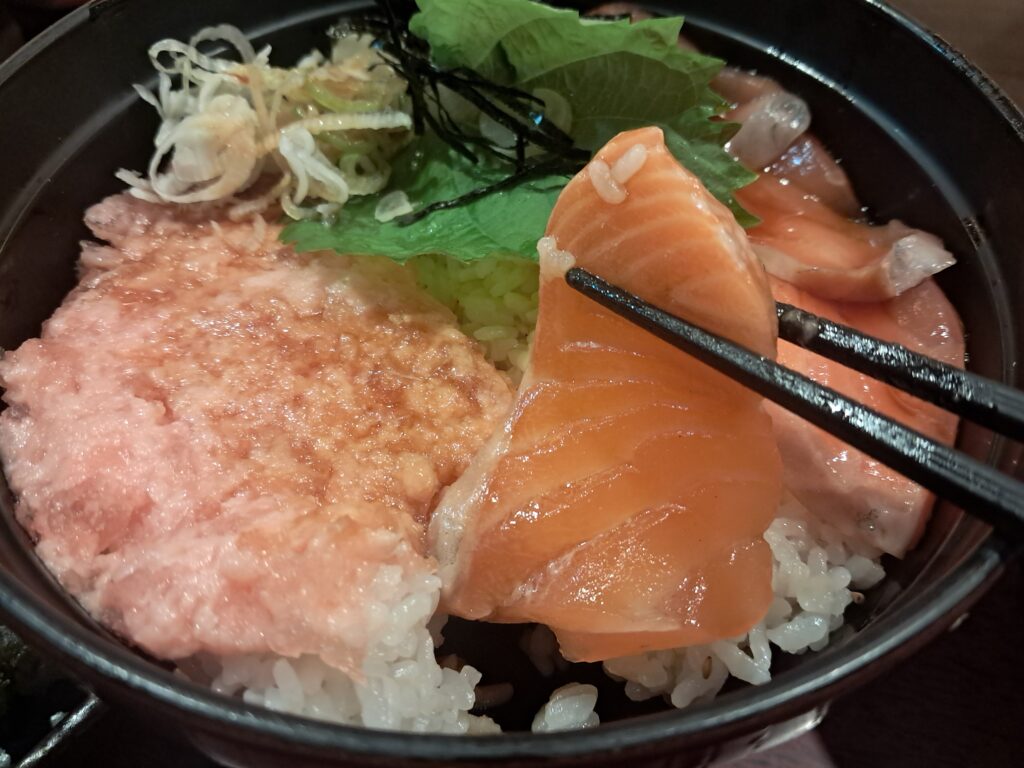
Not just the seafood, but the overall pricing feels slightly high, but hey, it’s Tokyo, so I suppose this is normal.
There are plenty of other seafood menu items like the sashimi set and the 5-seafood rice bowl, so grabbing some sashimi and a drink after your bath sounds like a great idea!
Conclusion: Comprehensive Evaluation & Recommended Points
With all that said, THE SPA Nishiarai scores higher for its non-bathing facilities than its actual baths.
Let me hand down a comprehensive evaluation of this facility based on Nobuyo’s subjective view.
・Access: 10/10
・Uncrowdedness: 8/10
・Staff: 4/10
・Bathing Area Openness: 2/10
・Cleanliness: 3/10
・Hot Spring Quality: 6/10
・Bath Variety: 3/10
・Sauna: 4/10
・Changing Room Amenities & Supplies: 4/10
・Convenience of Facility System: 4/10
・Clientele Quality: 6/10
・Atmosphere: 5/10
・Food: 7/10
・Resting Space: 8/10
・Cost Performance: 5/10
・Overall: 5.3/10
So there it is. A score in the 5s generally means “neither good nor bad,” but from Nobuyo’s perspective, it’s more like, “It has good points, but the bad points really stand out too.”
The overwhelmingly best thing about THE SPA Nishiarai is just its close-to-the-station location.
When you’re on your way home from work thinking, “Ah… I want to refresh myself in a hot spring and sauna…,” being able to just hop off the train and easily pop in is a massive advantage.
Also, the high quality of the resting space earns high marks.
Unusually for a hot spring facility in Tokyo, you can feel their spirit (?) of “We won’t just end this with a bath and a meal!”
On the flip side, honestly, the rest of the facility was mediocre.
The biggest reason for this is that I went on a day when my side had the lame bath, but to begin with, it makes no sense that there’s such a massive disparity between the two baths.
For that reason, personally, I don’t think I’ll be repeating my visit… actually, I kind of want to pinpoint a day with the heavenly bath and try going again…
Anyway! Make absolutely sure you visit on a day when the bath for your gender is the heavenly bath. If you’re a man, go on days ending in 0 or 5, and if you’re a woman, go on any other day.
Otherwise, you’ll be stuck with a lame bath featuring only one stinky sauna, crying tears of regret…
Comments